Korea Laundry: Why Coin Laundries Sell Dryers, Not Washers
In a lot of American buildings, laundry is not a chore so much as an appointment. You gather quarters or load a payment card, carry a basket down to a room with four machines for forty apartments, and hope two of them are free. If the building has no room at all, the laundry goes in the car.
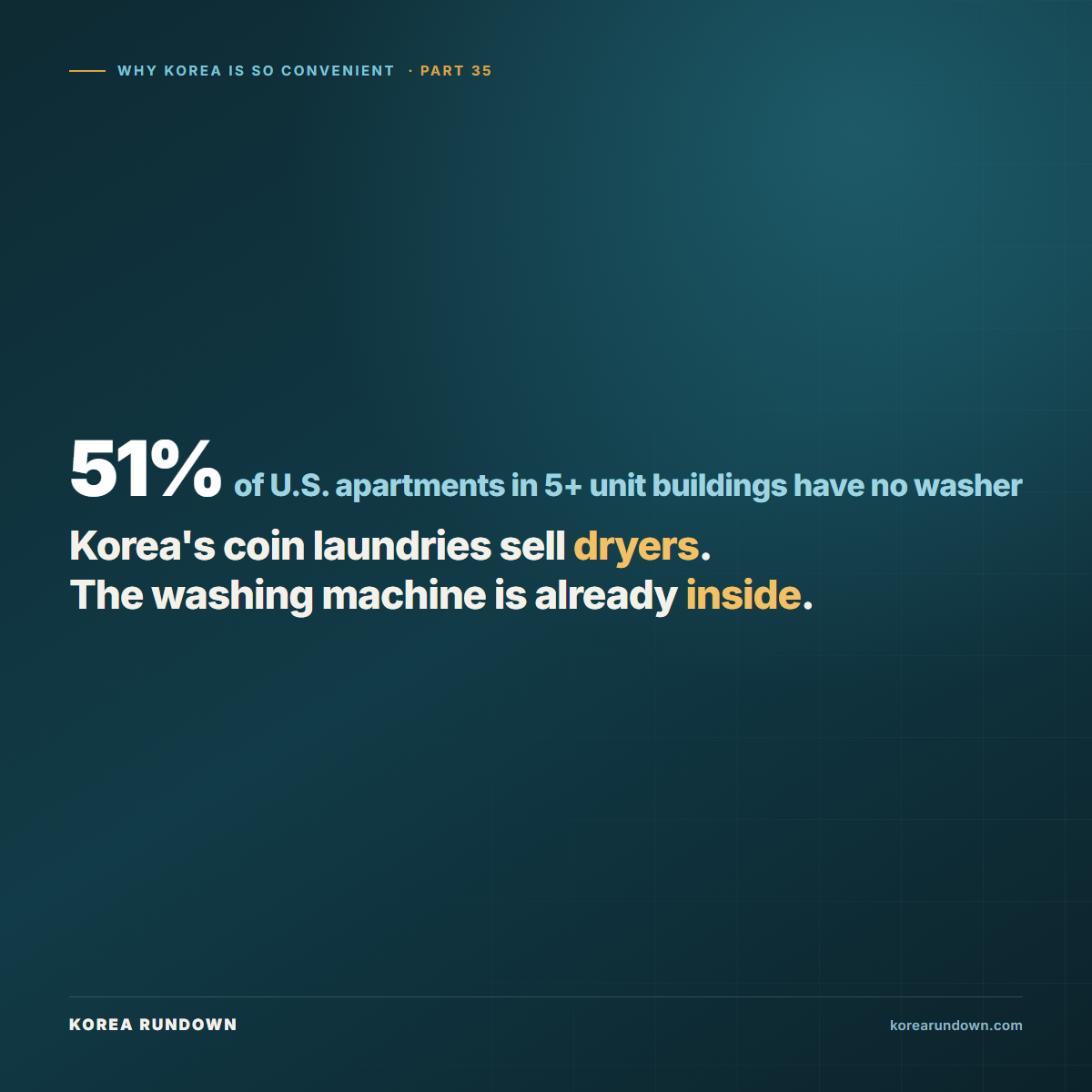
The federal residential energy survey counts exactly how common this is. Of 123.5 million U.S. homes, 19.6 million have no clothes washer where they live. Among apartments in buildings of five or more units, it is 11.7 million — 51% of them.
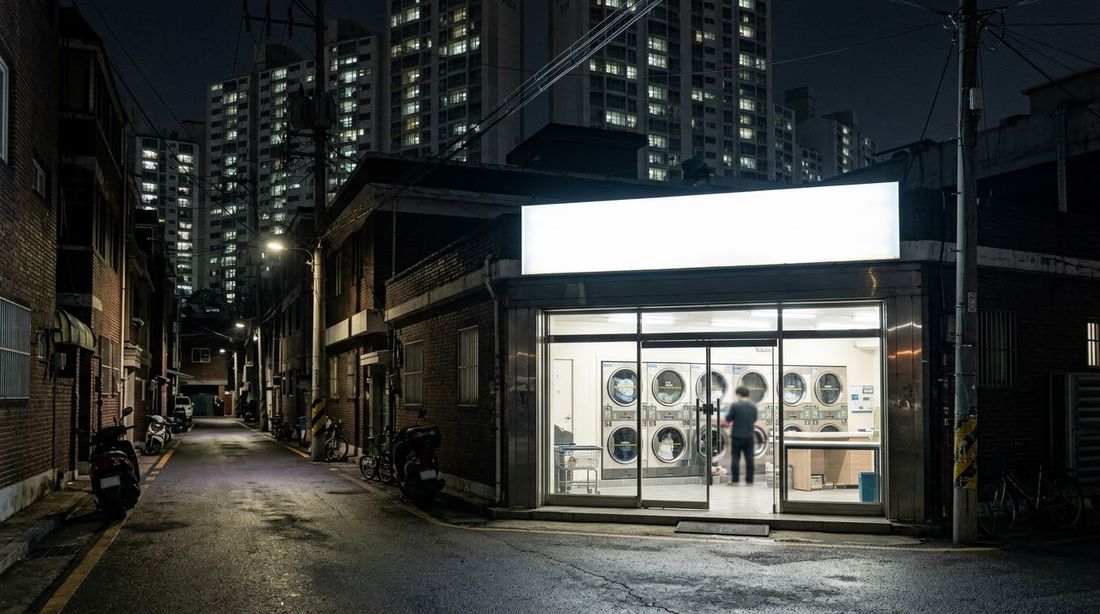
Korea has self-service laundries on an ordinary residential block too, often two or three within a ten-minute walk, open around the clock and unstaffed. They are not there for people who have no washing machine.
What the American number is actually measuring
Split that survey by building type and the story stops being about money. Detached single-family houses have a washer 97.7% of the time. Apartments in buildings of five or more units: 48.9%. The same split appears for dryers, where 52% of those apartments have none.
That is a construction decision, made once, decades ago in most cases, and effectively permanent. A washer needs a supply line, a drain, a vent or a condenser, and about six square feet that the floor plan never allocated. Adding it later means opening walls in a hundred units at once. So the building keeps a shared room in the basement, or it keeps nothing, and the household buys the service from a business down the street.
A Korean coin laundry sells the dryer, not the washer
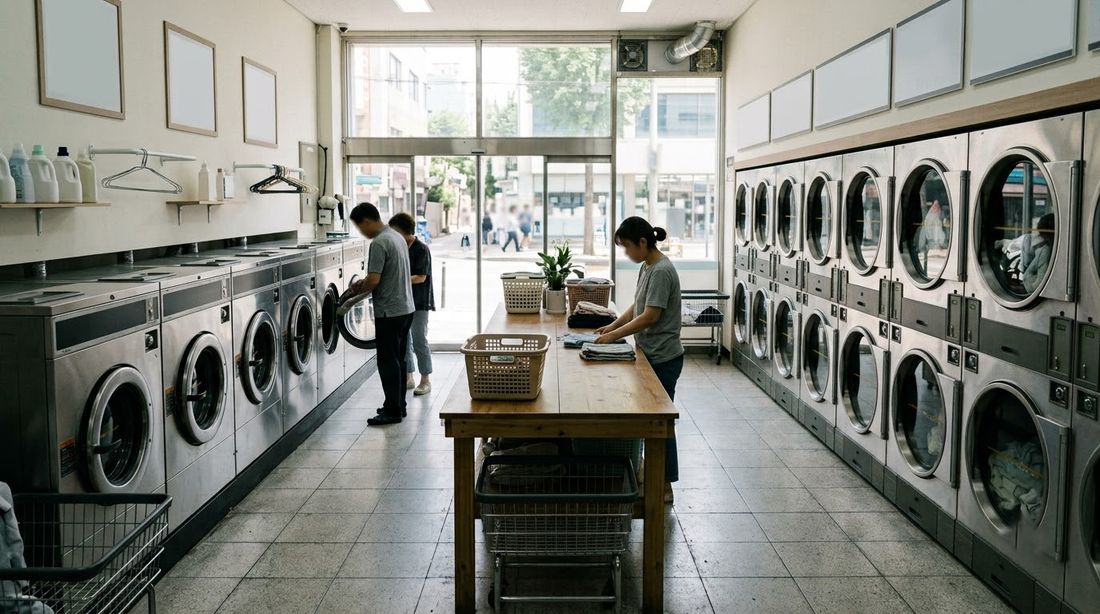
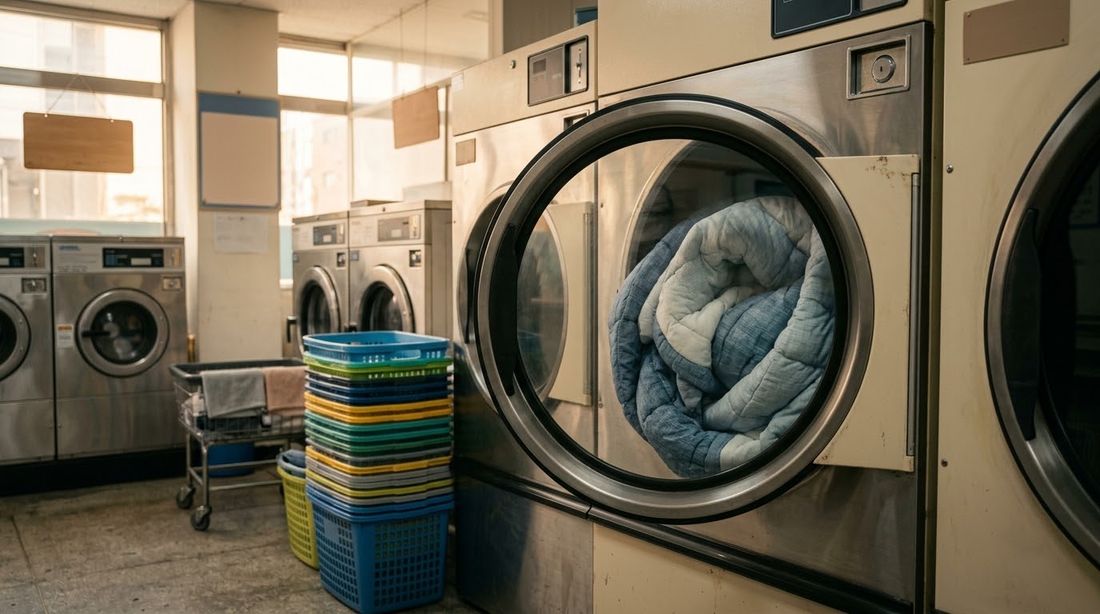
Walk into one and the machines are not sized for a week of shirts. They are sized for a winter comforter, a floor mattress, a set of blankets after a family visit, or a full load caught out by the rainy season. The washer at home handles the daily volume. The store handles the things that do not fit in it and the drying that an apartment cannot do in July.
How big is that market? Honestly, nobody publishes a reliable national count. Figures circulate, but no government body registers self-service laundries as their own category, so this post is not going to state a nationwide number. What can be verified is the largest operator: Cleantopia reports 1,148 coin laundry stores nationwide as of January 2026, and describes itself as the market leader by store count.
The balcony is the part that changed
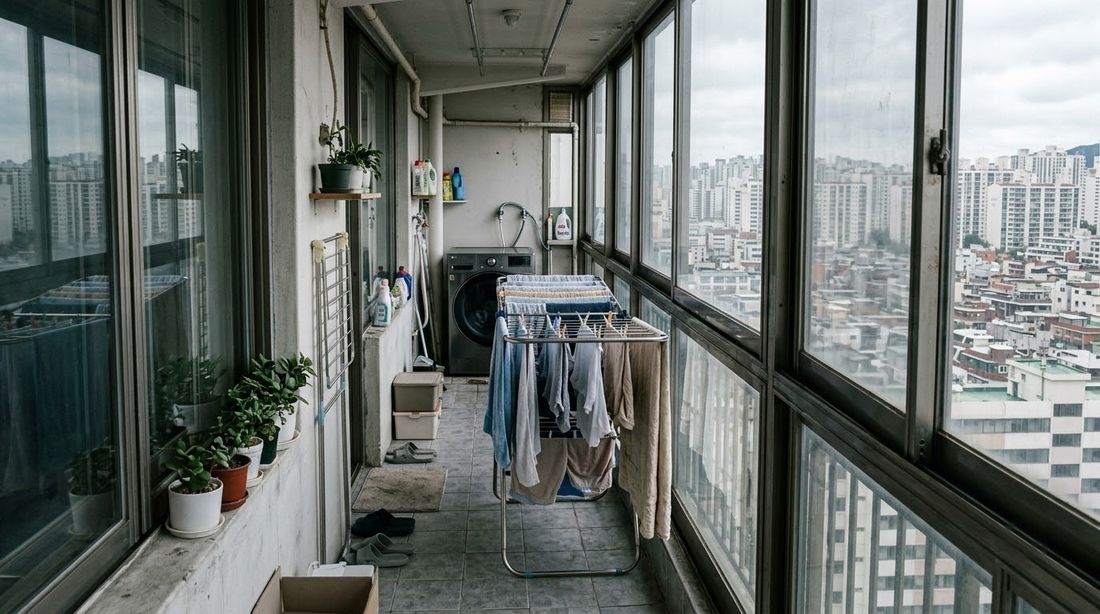
For most of the apartment era, Korean laundry dried on the balcony — a covered, glassed strip running the width of the unit, outside the insulated wall, where a drying rack could sit all day. It was not a luxury. It was where the washing machine lived and where the wet clothes went afterward.
Then the balcony became floor space. An amendment to the Building Act Enforcement Decree, effective 2 December 2005, allowed that strip to be converted for use as living room, bedroom or storage, with a structural-change filing. Buyers wanted the extra square meters and developers started selling floor plans with the conversion already priced in.
The washing machine stayed. The drying rack lost its room. A household that has swapped its balcony for a wider living room has to dry indoors, buy a dryer, or walk to a store that already owns one — which is where the demand for a machine you rent by the cycle comes from. It is the same household, in the same apartment, that simply no longer has the one architectural feature the old routine depended on.
The honest part
This is a thinner evidence base than most posts in this series. The American side rests on a national government survey with published tables. The Korean side rests on a company's disclosure of its own store count and on a mechanism — balconies converted, drying moved indoors — that is documented in law but not measured in any national statistic.
There is a business risk under the model, too. These stores are unstaffed for the same reason the unmanned shops in this series are: labor is the only cost a small operator can remove. The Fair Trade Commission issued a standard contract for self-service laundries in 2022 because damage disputes had no agreed baseline.
Where the density comes in
Here is the part that generalizes. A laundromat that sells a necessity — the only washing machine its customers can reach — has captive demand and can survive on a thin catchment. A laundromat that sells a supplement cannot. Every one of its customers already owns a washing machine and uses the store perhaps twice a month, for bedding, or during a bad stretch of weather.
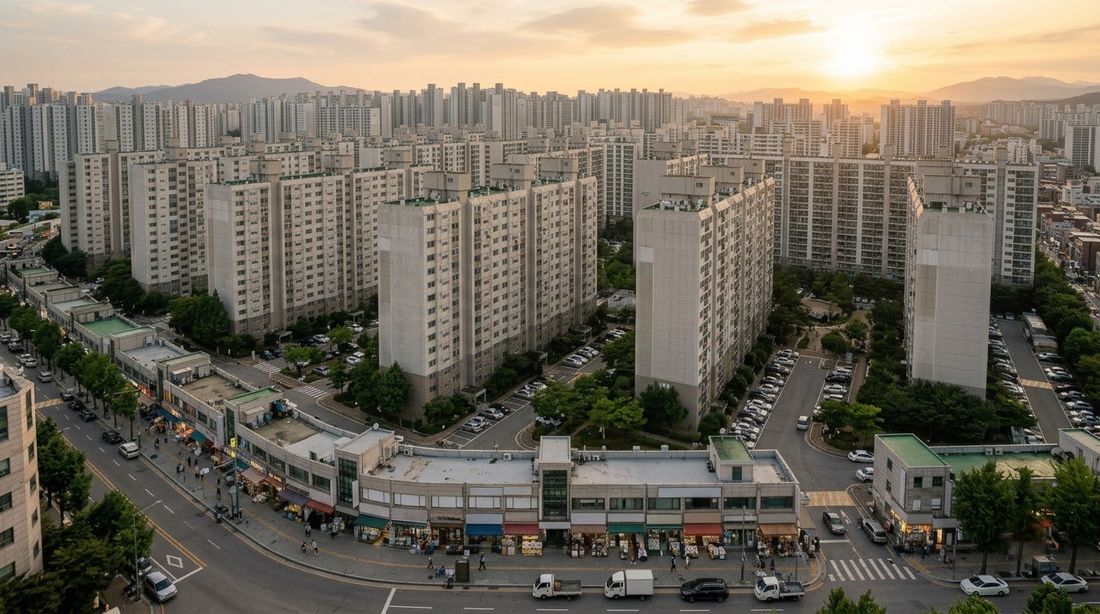
Run that math and the store needs an enormous number of households within walking distance to clear its rent, because it captures a small slice of each one. Ten apartment towers inside a five-minute radius will do it. A subdivision of detached houses, where the same errand means a car trip, will not.
So the two countries end up with superficially identical storefronts doing opposite jobs. In one, the coin laundry is infrastructure filling a hole in the housing stock. In the other, it is a convenience business that only pencils out because a thousand people with their own machines live within a short walk of the door.
This is part 35 of a series on why daily life in Korea feels so frictionless. Part 34 looked at why Korean cram schools sell a seat by the month instead of a tutor by the hour. Earlier parts are here.
Next in this series: why a phone keeps its signal in a Korean subway tunnel, and what it costs to wire the miles between stations.


Comments
Post a Comment