Korea 24 Hour Culture: Real, and Quietly Shrinking
It is 11:40 on a Tuesday night and you want food that is not from a gas station. The diner that used to be open all night stopped in 2020 and never went back. The 24-hour supermarket now closes at eleven. The Waffle House is forty minutes away and you would have to drive it. What is genuinely open near you at midnight is a drive-through, a convenience store attached to a gas pump, and an app that will deliver in ninety minutes if the restaurant accepts the order at all.
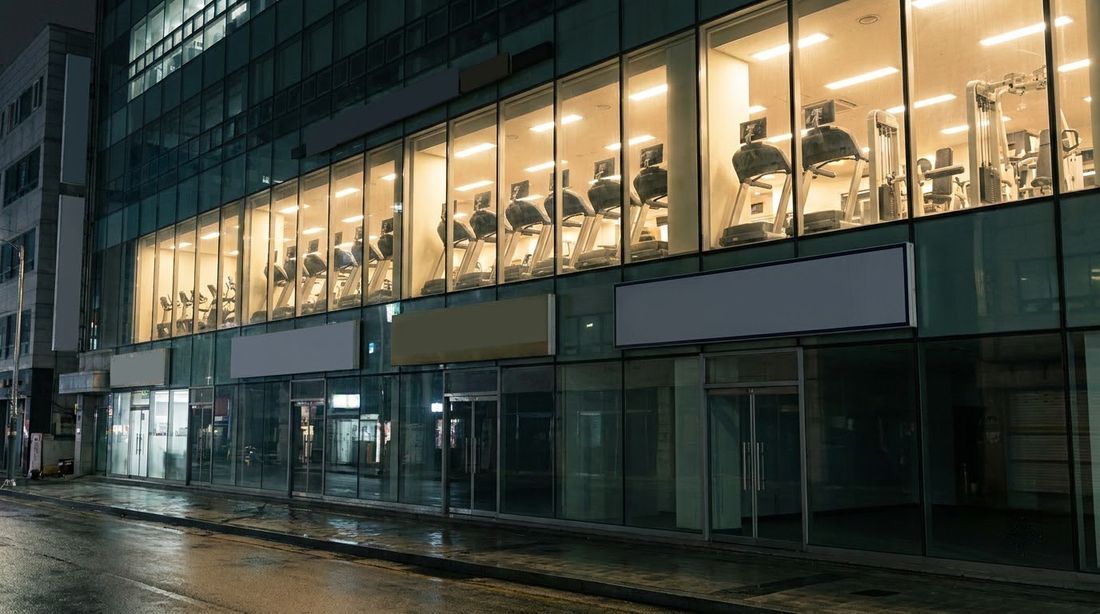
The Korean version of that hour is not exotic. It is a lit box on the corner with a glass front, and you walk to it.
Inside there is a counter along the window, a hot water dispenser, two microwaves, and a bin of free plastic utensils. You pick a cup noodle off the shelf for about ₩2,000, fill it at the dispenser, and eat it standing at the window with the sound on your phone off. Nobody treats this as remarkable. It is the default late meal for students, night-shift workers, and anyone who did not want to cook.
This is the part of Korea that gets described as a 24-hour society, and the description is true. It is also, right now, shrinking. That is the more interesting story, and it is the one this post is actually about.
The number that decides whether a light stays on
Korea’s statutory minimum wage for 2026 is ₩10,320 an hour, set by the Ministry of Employment and Labor. That is a 2.9% rise on the previous year’s ₩10,030, and it applies to every industry with no sectoral carve-outs.
For a workplace with five or more employees, hours worked between 10 p.m. and 6 a.m. carry a statutory 50% premium under Article 56 of the Labor Standards Act, which puts the overnight hour at ₩15,480. For a workplace with fewer than five employees — which describes most individual convenience stores and most small PC bangs — that premium does not legally apply, and the overnight hour costs the same ₩10,320 as the afternoon one.
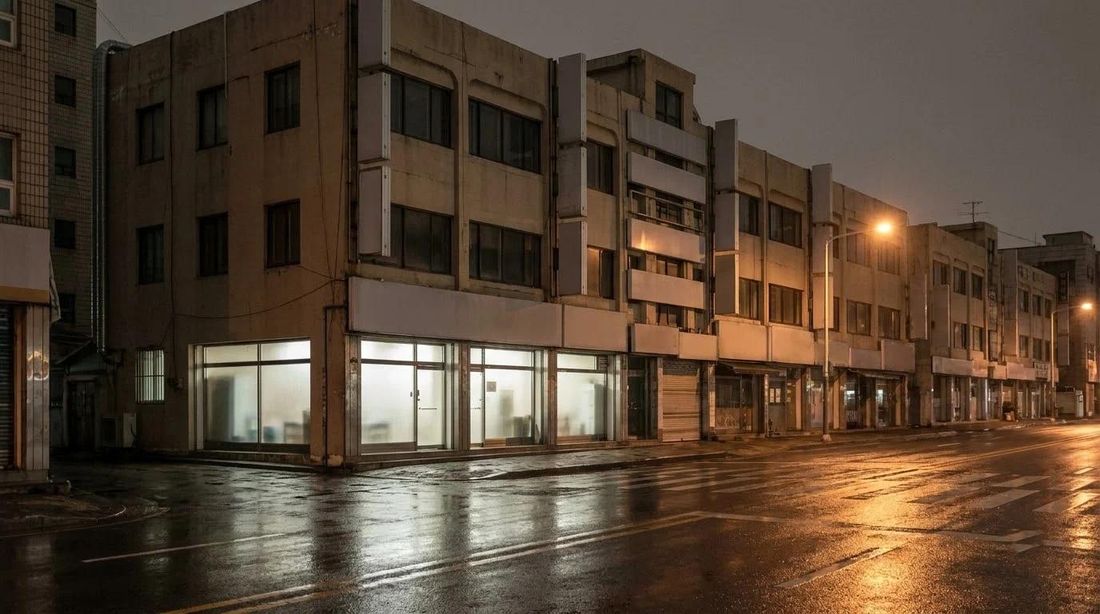
Either way, the arithmetic an owner runs at 2 a.m. is the same shape. Eight overnight hours cost somewhere between roughly ₩82,000 and ₩124,000 in wages alone. If the store does not clear that in overnight margin, the rational move is to lock the door at one and reopen at six.
Increasingly, that is what happens.
What is dying, and what is not
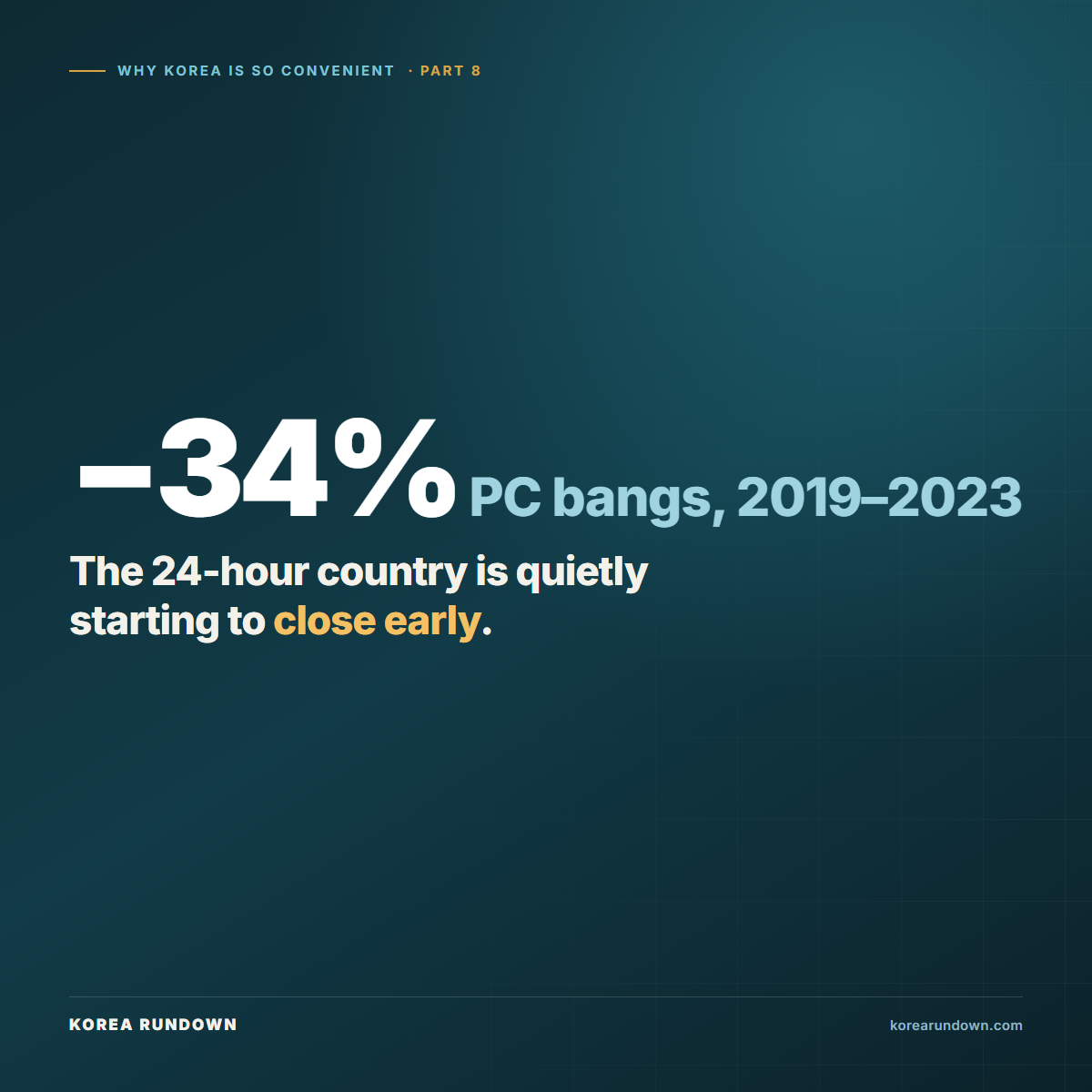
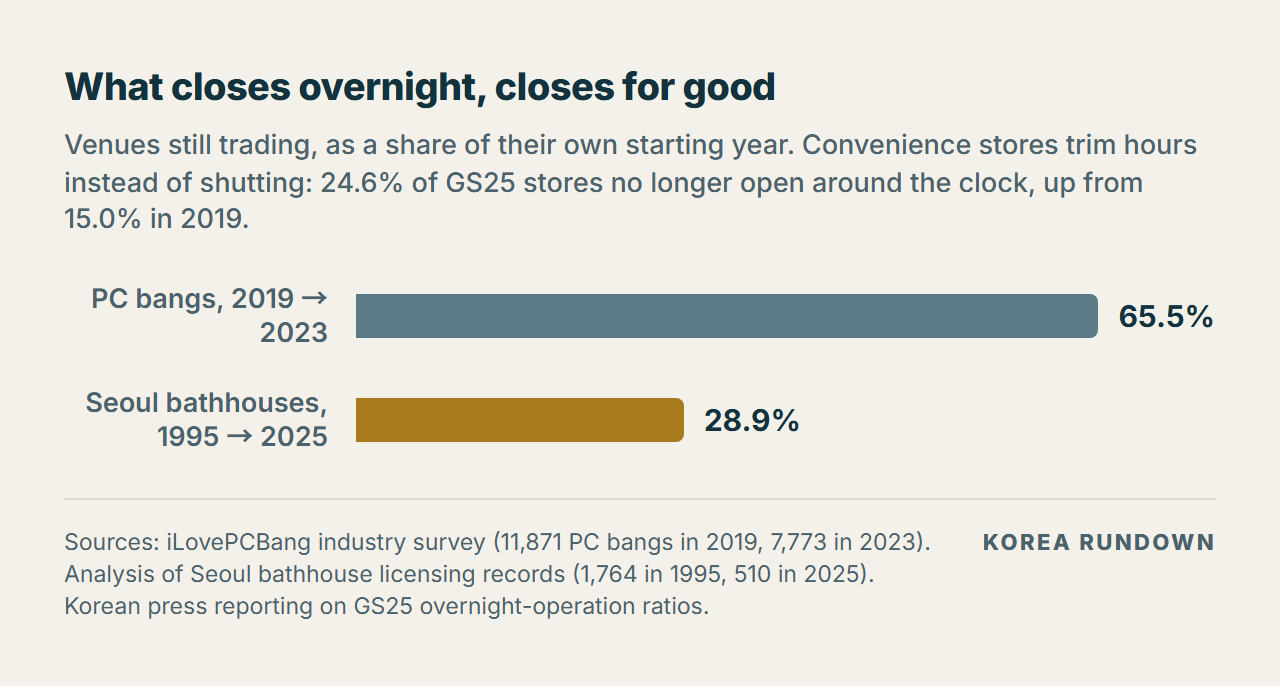
The PC bang — the all-night gaming café that anchored a whole era of Korean youth culture — went from 11,871 venues in 2019 to 7,773 in 2023, a fall of about 34% in four years, with the decline running four years straight. Industry surveys in 2025 put the working figure lower still.
The bathhouse decline is older and steeper. An analysis of Seoul’s bathhouse licensing records found the city peaked at 1,764 in 1995 and had 510 still trading in 2025 — a 71% loss over thirty years. Three shocks did most of it: the 1997 financial crisis, the shake-out after the early-2000s jjimjilbang boom, and the pandemic, which closed 242 of them in Seoul alone across 2020–2022.
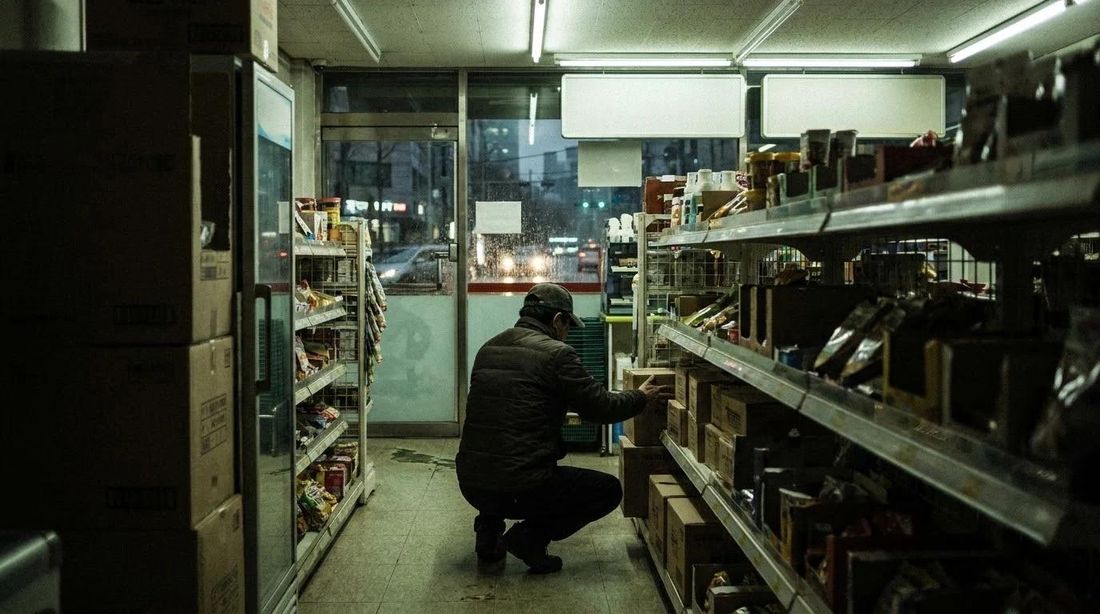
Convenience stores, by contrast, are not closing. They are just trimming. The share of GS25 stores not operating around the clock rose from 15.0% in 2019 to 24.6% in the most recent reported year, climbing steadily through every year in between; CU reports roughly 17%. The chains’ own explanation is unglamorous and entirely believable: overnight revenue no longer covers the overnight labor.
The structural rule underneath
Put the three trends next to each other and a rule falls out. What survives overnight in Korea is whatever needs the least floor space and the fewest staff per customer served.
A convenience store is about 40 square meters with one person behind the counter. Its catchment is the several thousand people living in the towers within a few minutes’ walk. At 3 a.m. it needs to sell very little to justify one wage, because it is only paying for one wage and a small footprint. That is why it trims to 18 hours rather than dying.
A jjimjilbang is a multi-floor building running boilers all night with staff on several floors. A PC bang is a hundred machines, a lease scaled to hold them, and hardware that has to be replaced on a cycle whether or not anyone is sitting at it. Both need a large number of overnight customers to clear their overnight cost. Density gave them those customers for a couple of decades. Rising wages, cheaper home hardware, and a generation that games on a phone took the customers away, and the cost structure did not shrink to match.
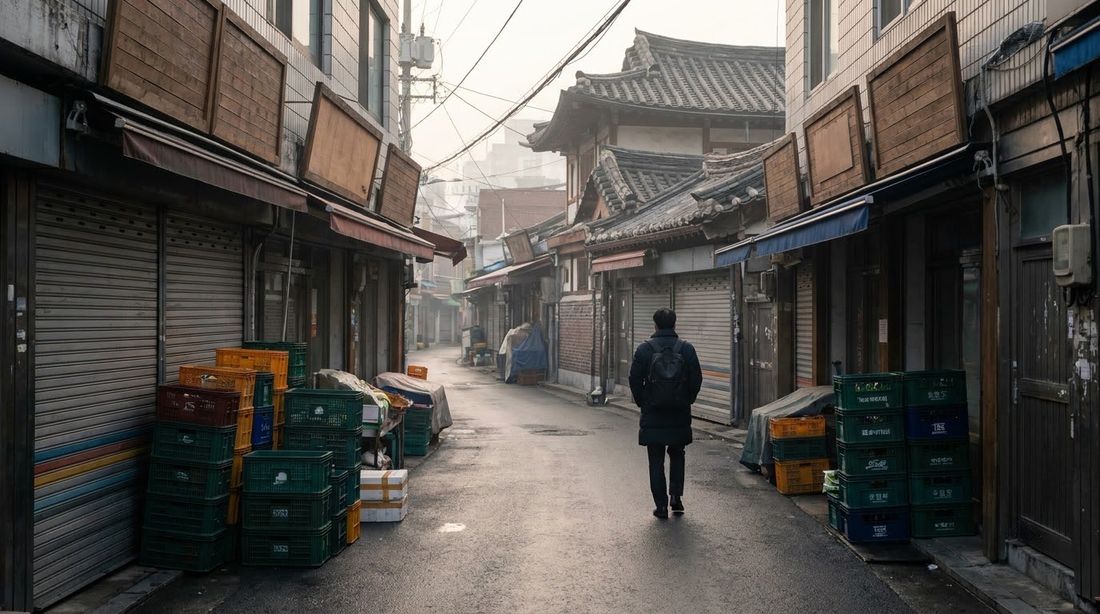
So the honest version of “Korea is a 24-hour country” is narrower than the postcard. Korea is a country where the specific businesses that can be run overnight by one person, in a small box, inside a dense residential catchment, are still running overnight. Everything with a bigger footprint is on a downward line.
Which is the same argument this series keeps arriving at from different directions. Not national character, not a cultural taste for staying up. Just what the maths permits when you stack enough people close enough together — and what it stops permitting when the wage floor rises faster than the foot traffic.
This is part 8 of a series on why daily life in Korea feels so frictionless. Part 7 covered why a gigabit internet line lists at about $28 a month. Earlier parts are here.
Next in this series: why Korea has more cafés per person than almost anywhere on earth, and why so many of them are full of people who bought one coffee four hours ago.


Comments
Post a Comment