Korean First-Graders Walk to School Alone. Illinois Says You Must Be 14 to Stay Home.
You have done the drive twice a day for years. Out of the subdivision, left at the light, into a queue of forty cars idling along the school loop, and back. It is fifteen minutes each way and it is not optional, because there is no sidewalk for most of it and the one stretch that has one runs beside a road where cars do 45 miles an hour.
Somewhere in the back of your mind is the other reason. In 2015 a Maryland couple was investigated for letting their children, aged 10 and 6, walk home from a park. Utah passed the country’s first free-range parenting law in 2018 specifically so that letting a child walk to school alone could not be treated as neglect. Whether you are legally at risk depends entirely on your state, and most states have not said.
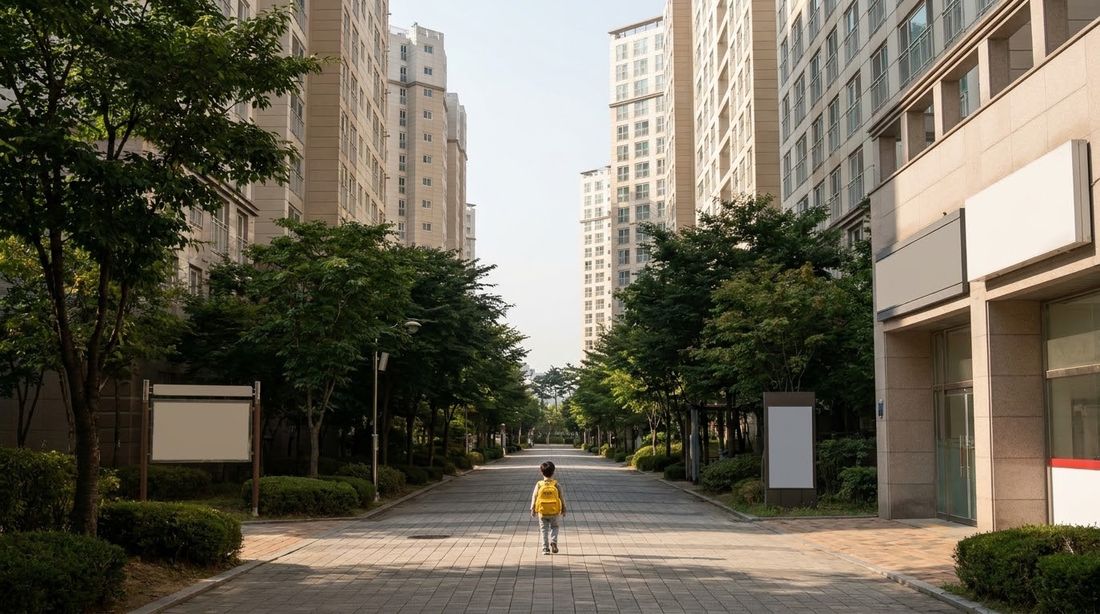
In Seoul a six-year-old in a yellow backpack walks to school by herself, and no adult in the country finds this remarkable.
What the law actually says in each country
Start with the American numbers, because they are the ones that surprise Koreans.
Most US states — 34 of them — have set no legal minimum age for leaving a child unsupervised. Among the states that have, the range runs from 6 in Kansas and 8 in Maryland and North Carolina up to 14 in Illinois, the strictest. The American Academy of Pediatrics generally suggests waiting until 11 or 12. So the same nine-year-old is unremarkable in one state, a call to Child Protective Services in another.
Korea approaches it from a completely different direction. There is no minimum age rule for walking to school, because the question the law asks is not how old is the child but how far is the school and how fast do cars go near it.
Utah passed the first free-range parenting law in 2018
Zones cover roads within 300 m of the school gate, speed capped at 30 km/h
The 1.5 kilometre rule, and why it is achievable
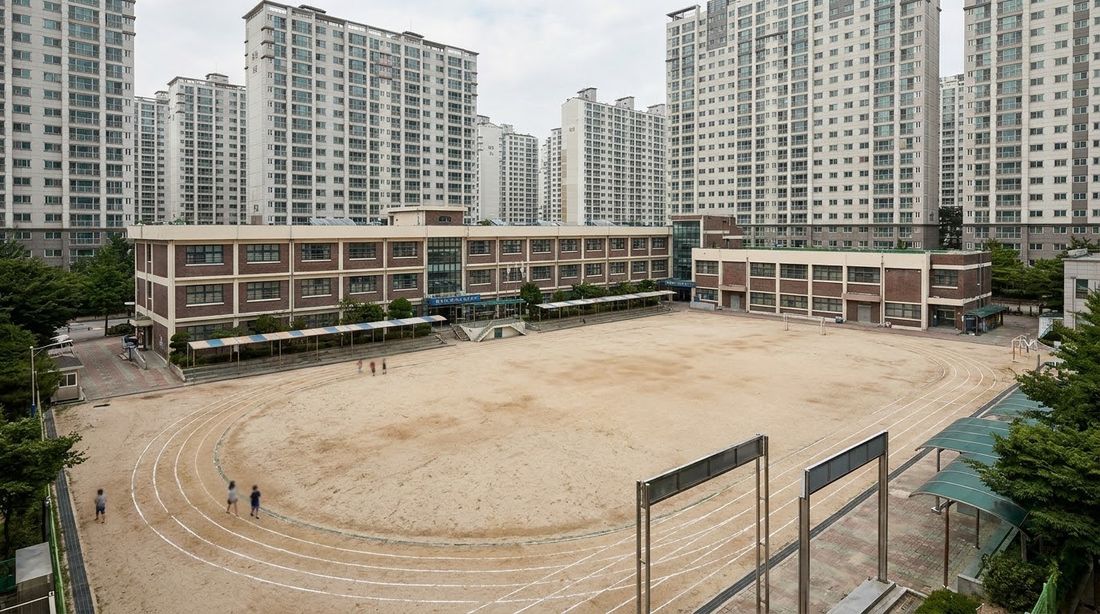
Korean regulation sets elementary school catchments so that the walk is within about 1.5 km, with school siting assessments using a walking time standard of roughly thirty minutes. Korean educators argue that 1.5 km is too generous — it is based on an adult’s pace, and a small child needs closer to fifty minutes to cover it. That argument is worth noticing, because it tells you the debate in Korea is about whether the walk is too long, not whether it should happen at all.
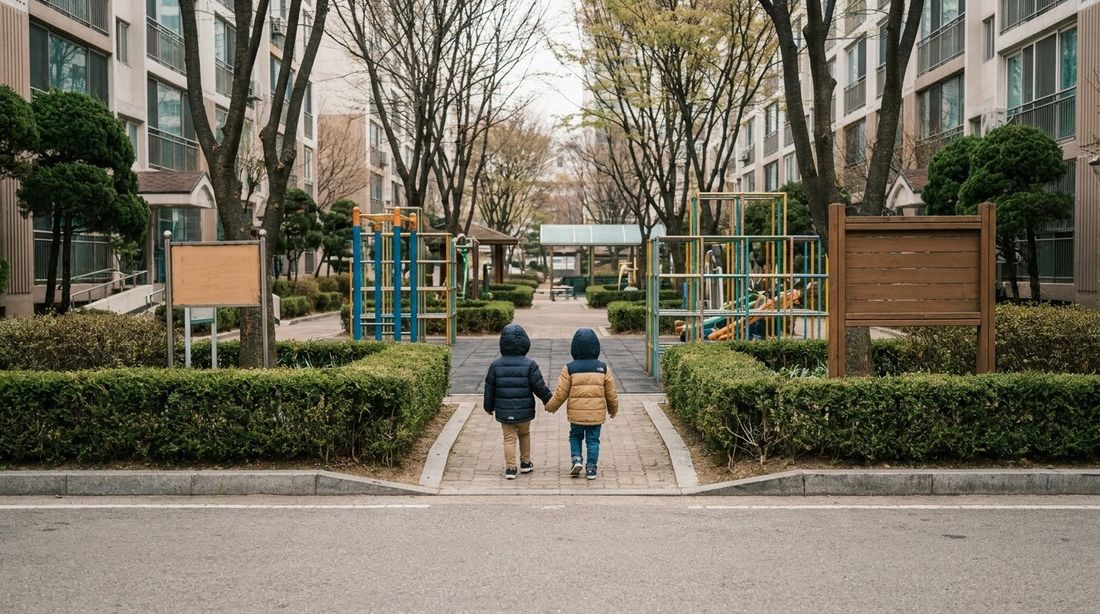
Now ask why a 1.5 km catchment is even possible. In a place where several thousand people live within a few hundred metres, a single elementary school reaches its entire student body inside that radius. Drop the same rule on a subdivision of quarter-acre lots and the catchment has to stretch for miles, at which point walking stops being an option and the school bus — or the parent’s car — becomes the only answer.
This is the same arithmetic as every other part of this series. A fixed piece of infrastructure serves an enormous number of people because they are stacked close to it.
The 300 metres that do the real work
Distance alone would not be enough. The other half is what happens on the road.
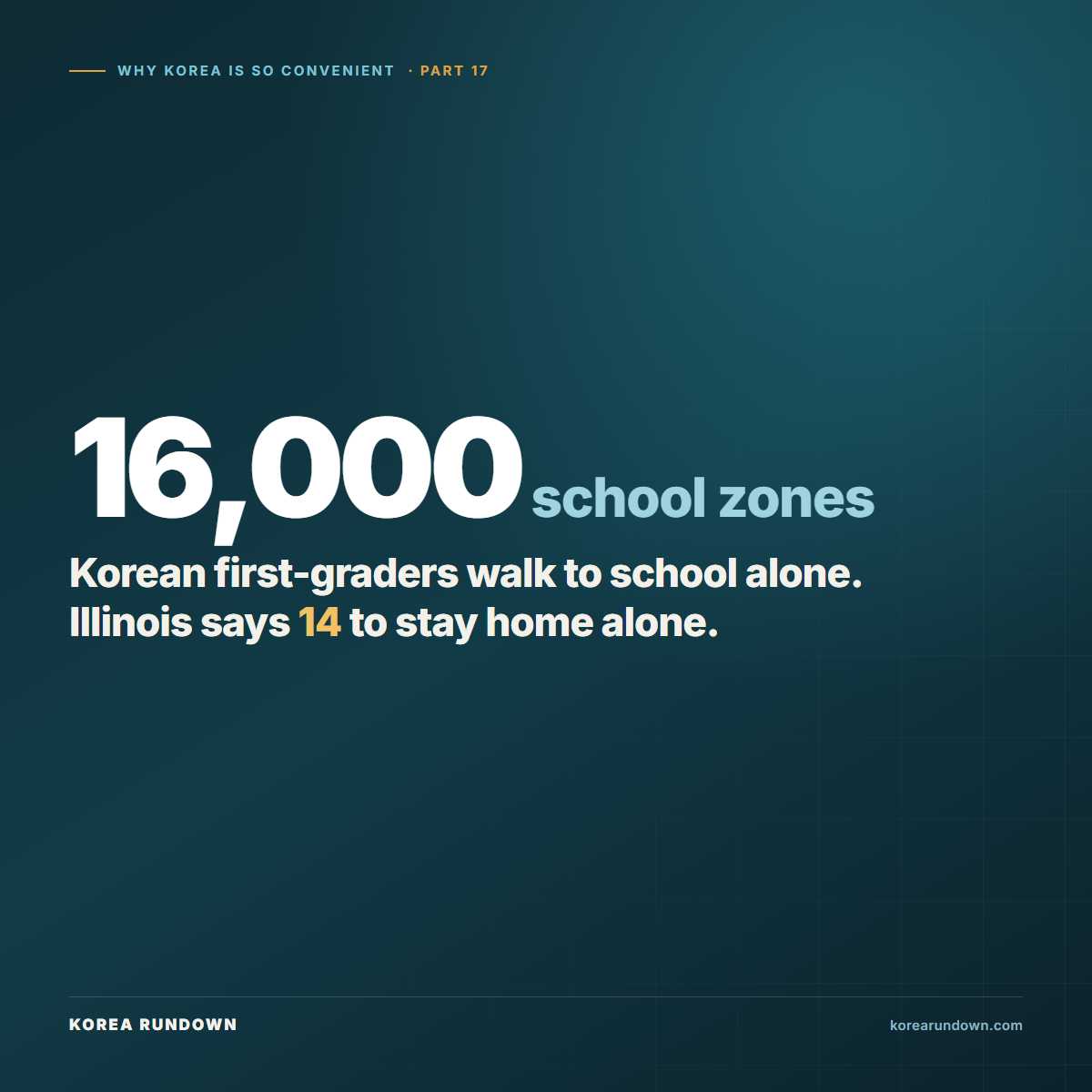
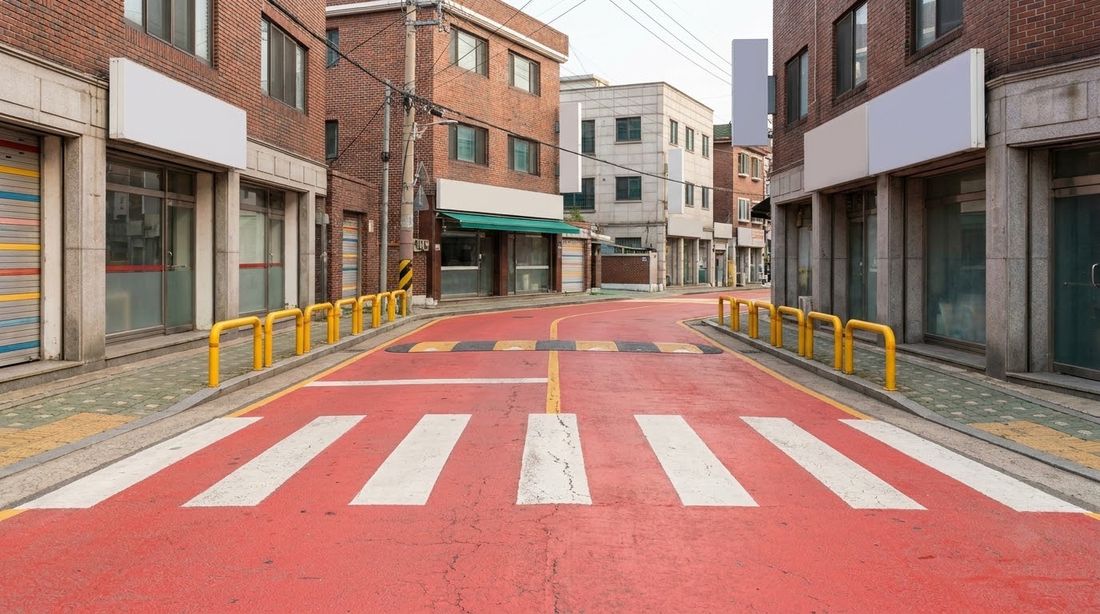
Korea designates child protection zones — school zones — on roads within about 300 m of an elementary school gate, and inside them the speed limit is capped at 30 km/h, roughly 19 mph. There are on the order of 16,000 of these nationwide. Seoul has been lowering selected zones further, to 20 km/h.
The effect is that the dangerous part of an American school walk — a stroad with 45 mph traffic and intermittent sidewalk — largely does not exist on the Korean route. The walk happens on interior streets between apartment blocks and then through a zone where the legal speed is a third of an American arterial.
So the Korean child is not braver. The Korean child is walking somewhere else.
The honest part
Three things.
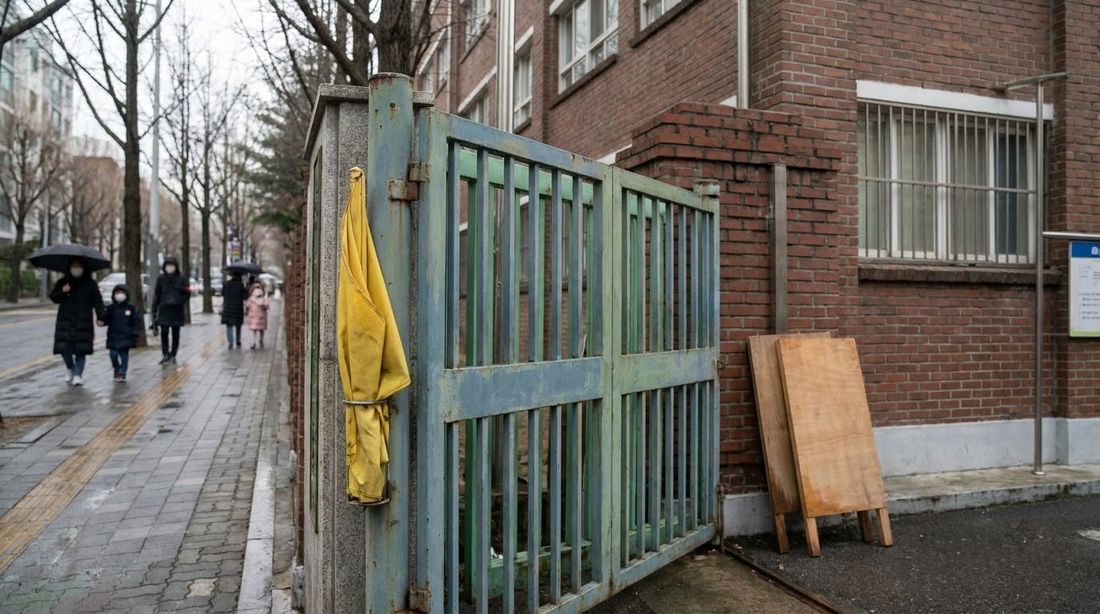
First, a gap we could not fill. We looked for a Korean statistic on what share of elementary students actually walk to school unaccompanied, and could not find one we would publish. The practice is obviously common — it is visible on any weekday morning — but "obviously common" is not a number, and we are not going to invent one.
Second, the school zone system exists because children were being killed. It was strengthened after specific deaths, and Korean parents do not experience these zones as a pleasant urban feature. They experience them as a minimum that had to be fought for. Enforcement is uneven, and Korea has been arguing publicly about relaxing the 30 km/h limit at night — as of the last reporting we saw, time-based relaxation applied to only 78 of the roughly 16,000 zones.
Third, the American comparison is not a story about American parents being fearful. In a country where a state may set the threshold at 14, or set none and leave it to a caseworker’s judgement, driving your child is the rational choice. The behaviour follows the rules and the roads, in both countries.
What density actually buys you
Take the density away and the Korean arrangement collapses on both sides. The 1.5 km catchment becomes unreachable, so the walk ends. The 300 m school zone becomes a rounding error on a route that is mostly arterial road, so the protection ends too.
What looks like a cultural difference in childhood independence is, once again, a difference in how far apart things are and how fast cars are allowed to move between them.
This is part 17 of a series on why daily life in Korea feels so frictionless. Part 16 described the apartment complex the whole series had been circling. Earlier parts are here.
Next in this series: groceries that arrive before six in the morning — and the half of the country that cannot get them.


Comments
Post a Comment