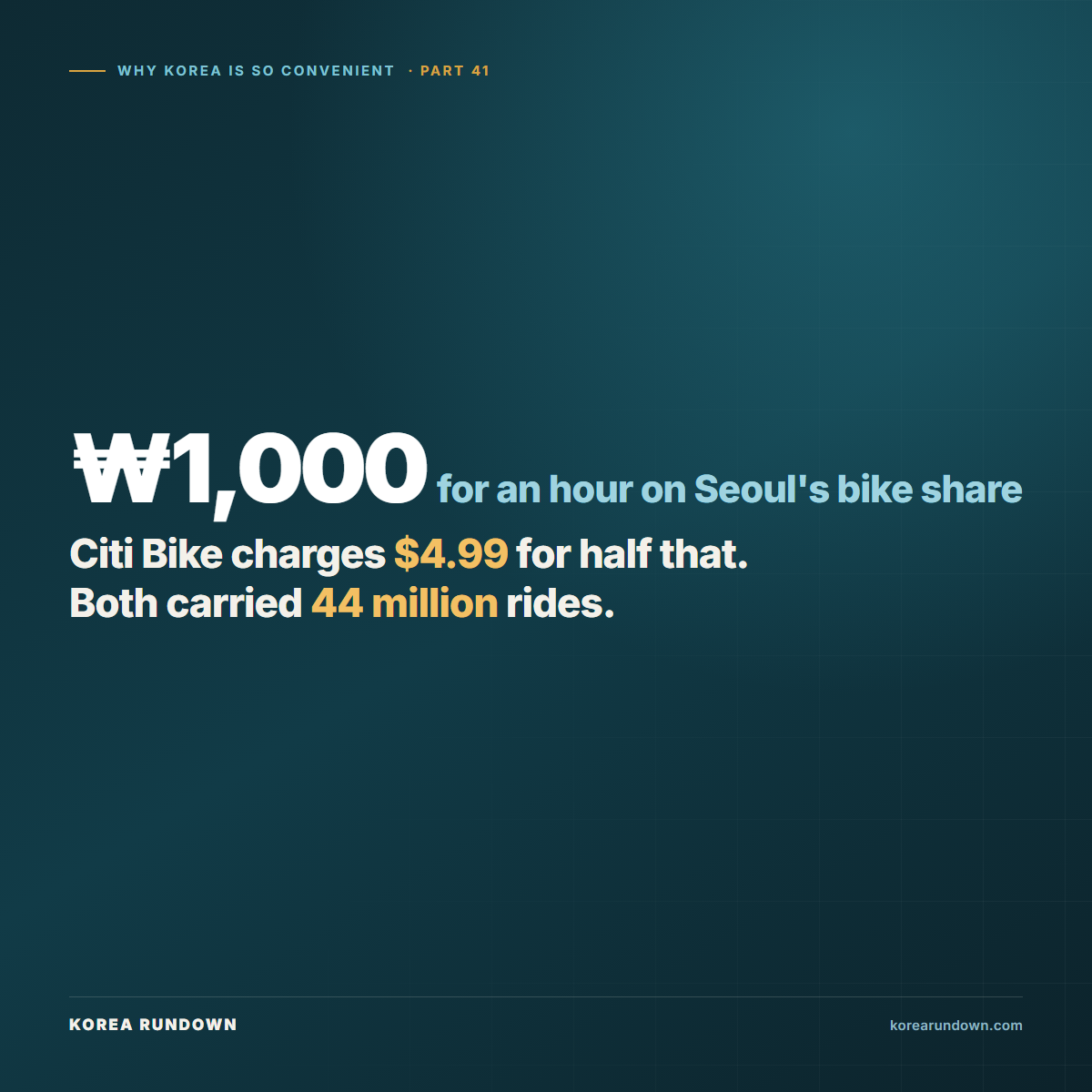
Seoul Bike Share Costs 1,000 Won an Hour. Citi Bike Charges $4.99 for Half That. Both Carried 44 Million Rides.
Your city got a bike share a few years ago. There was a ribbon cutting, a sponsor's logo on every fender, and a map of docks that covered downtown and a couple of neighborhoods next to it. The nearest dock to your apartment is a fifteen-minute walk, which is roughly the length of the ride you wanted to take. Then one spring the docks were gone, and a short notice said the program had ended.
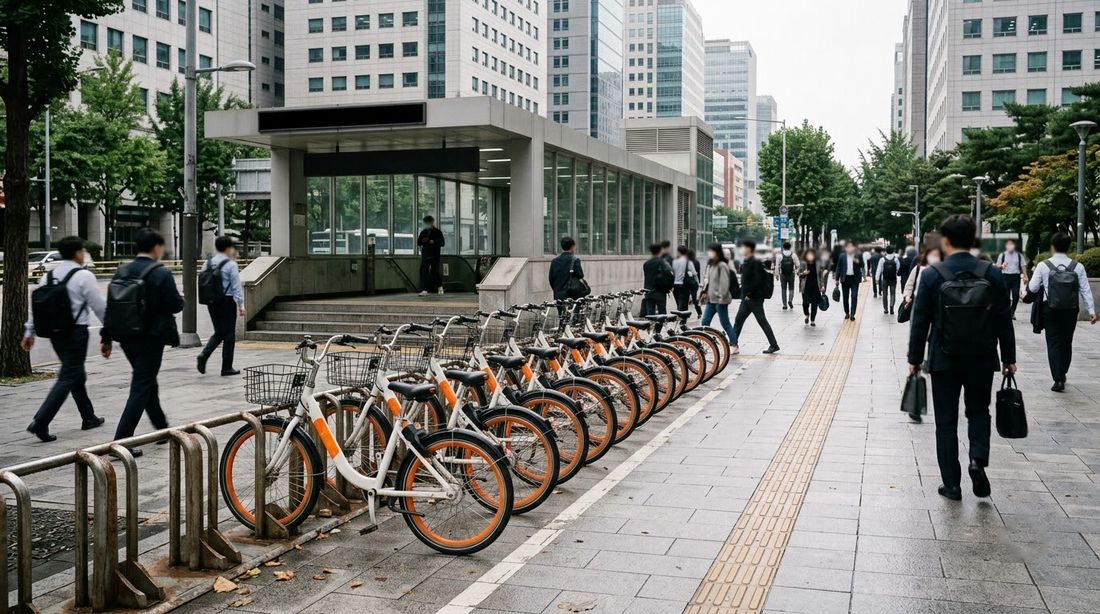
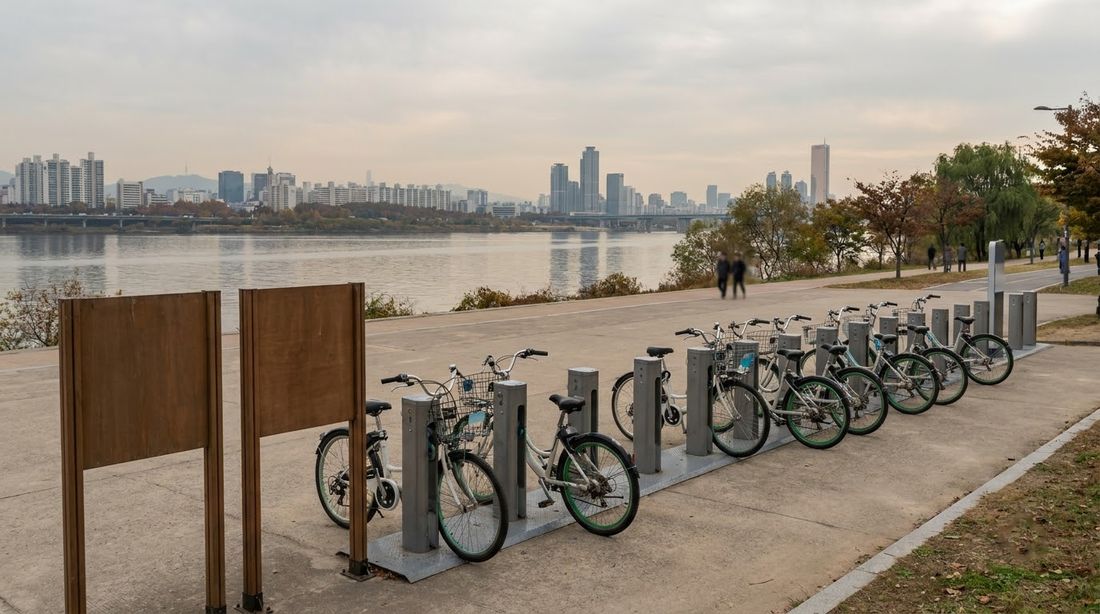
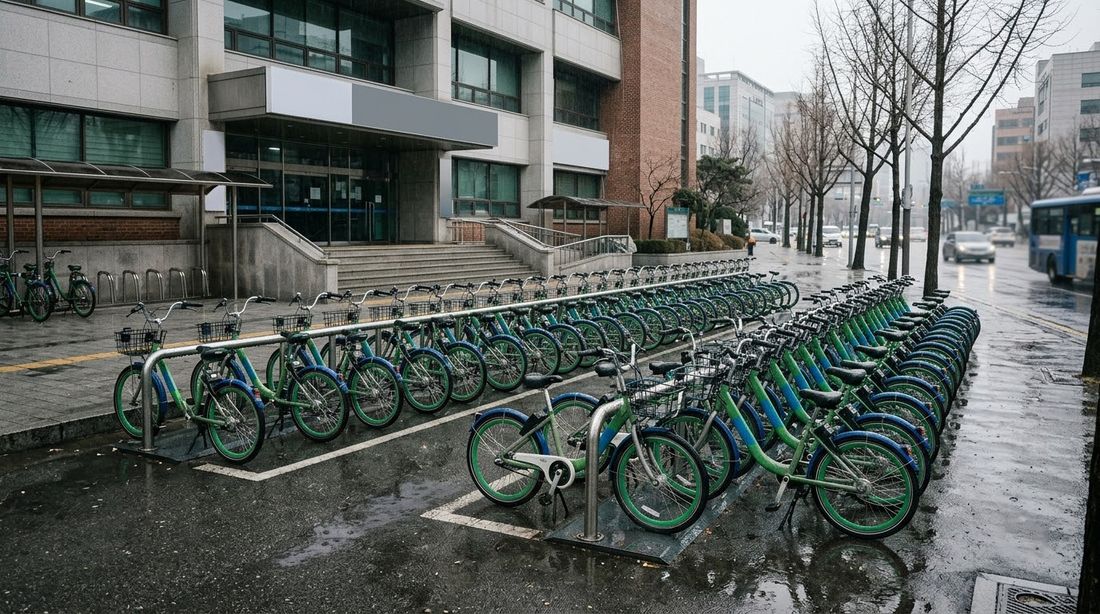
Seoul's bike share, called Ttareungyi after the sound of a bicycle bell, works differently. There is a rack at the subway exit, another outside the ward office, another by the river. You scan a code, ride for up to an hour, and pay 1,000 won — well under a dollar. Nobody treats this as remarkable, because it has been ordinary for years.
The easy explanation is that Koreans simply like bikes more, or that Seoul's government is unusually generous. Neither holds up well.
What Seoul bike share actually costs
The Seoul Facilities Corporation, which runs the system, lists the prices plainly. A one-hour day pass is 1,000 won. A two-hour pass is 2,000 won. A full year of unlimited one-hour rides is 30,000 won — less than New York charges for a single Citi Bike day pass. The operator puts the fleet at about 45,000 bikes at 2,800 stations as of 2025.
It did not start that way. The service launched in November 2010 with 440 bicycles. Annual rides went from about 113,000 in 2015 to 43.85 million in 2024, a roughly four-hundred-fold increase in nine years.
New York proves the American version works
Here is the part that undercuts the cultural explanation. New York's Citi Bike carried more than 44 million rides in 2024, by the city's own count — essentially the same number as Seoul. It had 2,150 stations in November 2024, with an expansion under way toward roughly 2,400 stations and more than 36,000 bikes.
So an American city can build a bike share of exactly Seoul's scale, and Americans will ride it at exactly Seoul's rate. What differs is the price.
| Published price | Seoul Ttareungyi | NYC Citi Bike |
| One ride, pay as you go | ₩1,000 for 1 hour | $4.99 for 30 minutes |
| Full year | ₩30,000, 1-hour rides | $239, 45-minute rides |
| Rides in 2024 | 43.85 million | 44 million+ |
The honest part: Seoul bike share loses money every year
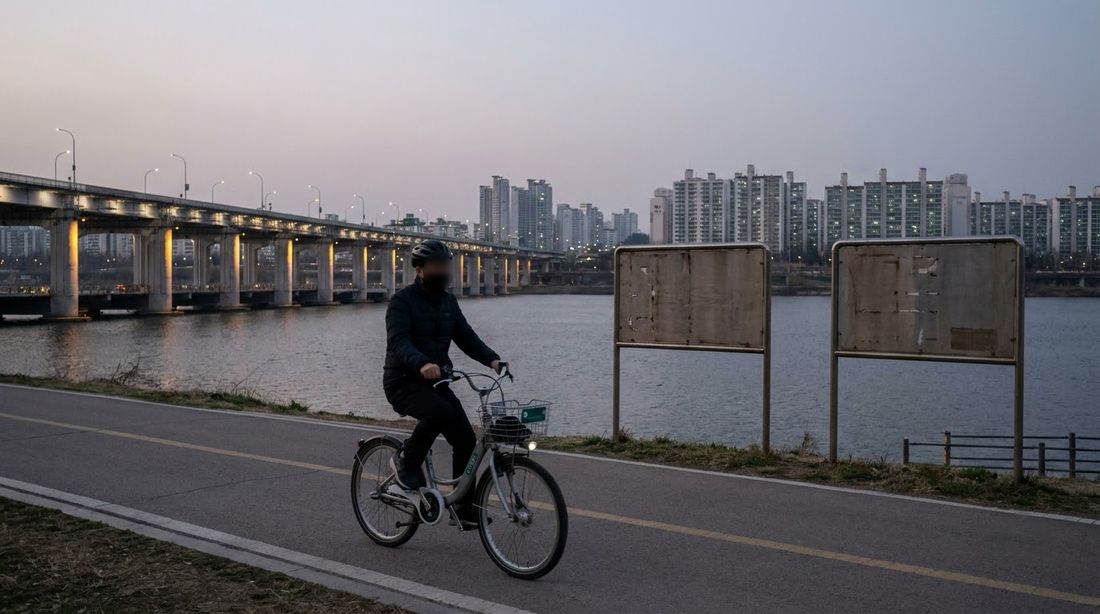
A price that low is not a business model. It is a subsidy, and the city says so. Reporting from late 2024, based on city figures, put Ttareungyi's annual operating loss at 9.9 billion won in 2020, 10.3 billion in 2021, 9.4 billion in 2022 and 10.9 billion in 2023 — roughly seven million dollars a year, every year. Even so, the same reporting said the fare had been frozen with no end date.
New York made the opposite choice. Citi Bike is run by Lyft, and the city's December 2024 announcement credited Lyft with paying for the next expansion. That is why the American fare is several times higher. Riders are covering the costs that Seoul's taxpayers cover.
Neither arrangement is obviously correct. Seoul's version means someone who never rides a bike helps pay for the person who does. New York's means a daily bike commute costs a real amount of money. Both are defensible.
Why Seattle's bike share closed and Seoul's did not
The more instructive comparison is a city where it did not work. Seattle's Pronto Cycle Share opened in October 2014 with 500 bikes at about 50 stations. The city bought it out of financial trouble in 2016 for $1.4 million, and on 31 March 2017 it shut down, citing ridership and revenue below what had been expected. The money set aside for a replacement was redirected to walking and cycling safety projects.
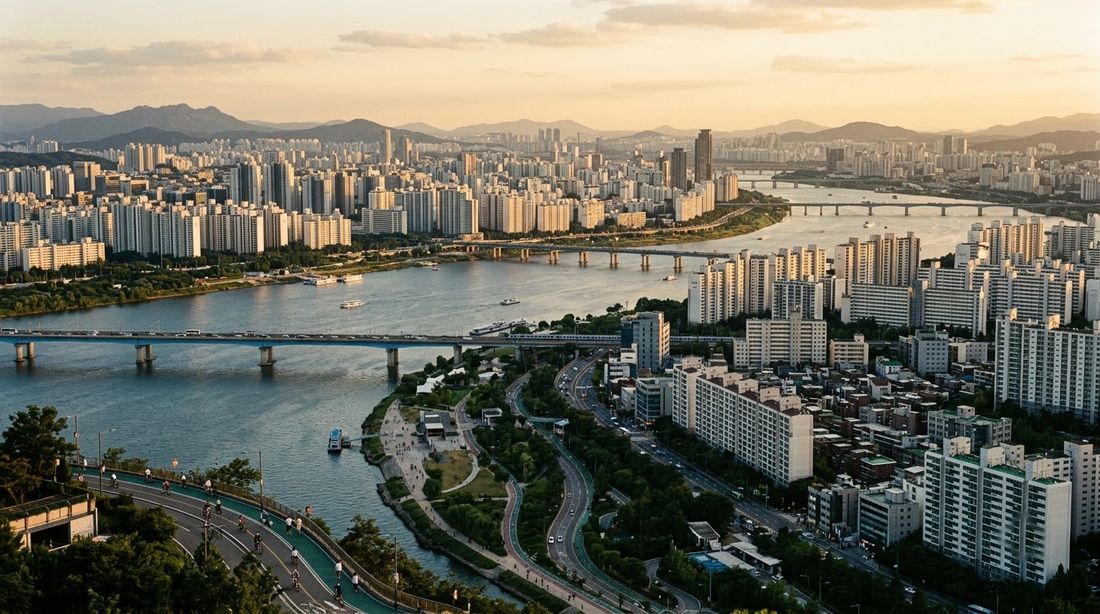
Nobody in Seattle forgot how to ride a bicycle. The trouble is arithmetic. A dock only earns its keep if enough people live, work or change trains within a couple of minutes' walk of it. Put 500 bikes across a spread-out city with long distances between destinations, and each dock sees a handful of trips a day. Put 45,000 across a city where apartment towers sit on top of subway stations, and the same dock is emptied and refilled all day.
Density decides where the docks can go
Bike share has a hidden requirement: the next dock has to be close enough that the walk to it does not cancel out the ride. That spacing is cheap to provide where people are packed together and ruinous where they are not. Seoul can afford thousands of stations because each one serves a crowd. A lower-density American city can afford a few dozen, and a few dozen is not enough to make the system useful.
New York is the exception that confirms the rule. It is the American city most like Seoul in how many people live on each block, and it produces Seoul's ridership at a price that covers its own costs.
The bicycle is the same everywhere. What changes is how many people are standing within two minutes of the rack.
This is part 41 of a series on why daily life in Korea feels so frictionless. Part 40 looked at why Seoul's bus arrival countdown is on the pole instead of only on your phone. Earlier parts are here.
Next in this series: the Korean post office, and why a country with fewer post offices per person than America still has one down the street.


Comments
Post a Comment