Korea Trash Rules: Why You Buy Your Own Bags and Weigh Food Scraps
Every other part of this series has argued that daily life in Korea is easier than daily life in America. This one argues the opposite, because on this chore it is plainly true.
Here is the American version. Everything goes in one bin — food scraps, packaging, the takeout container with sauce still in it. You roll the bin to the curb the night before pickup and in the morning it is empty. You do not sort, you do not weigh, and you do not pay at the point of throwing anything away; the cost is inside a municipal tax or an HOA fee you never itemise. Considered purely as a user experience, it is close to perfect.
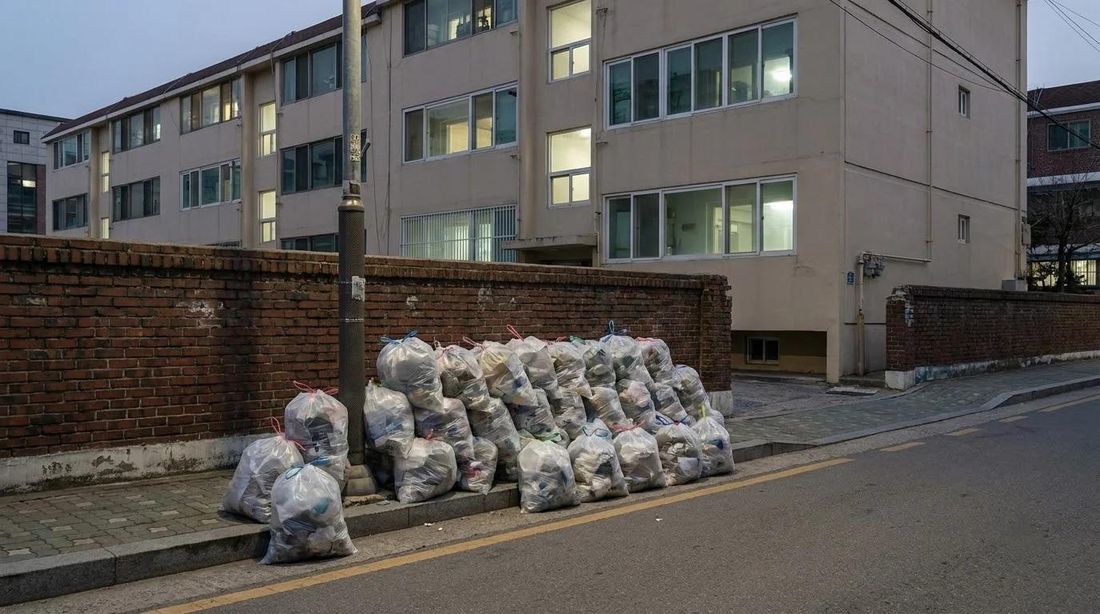
Here is the Korean version. You go to a convenience store and buy your garbage — specifically, a roll of official bags printed with the name of your district. In Seoul’s Gangdong district a 20-liter general waste bag runs about ₩490, roughly 36 cents, and every one of the 25 districts sets its own price by ordinance, so the bag from the next district over is not valid where you live. Only rubbish in that bag gets collected.
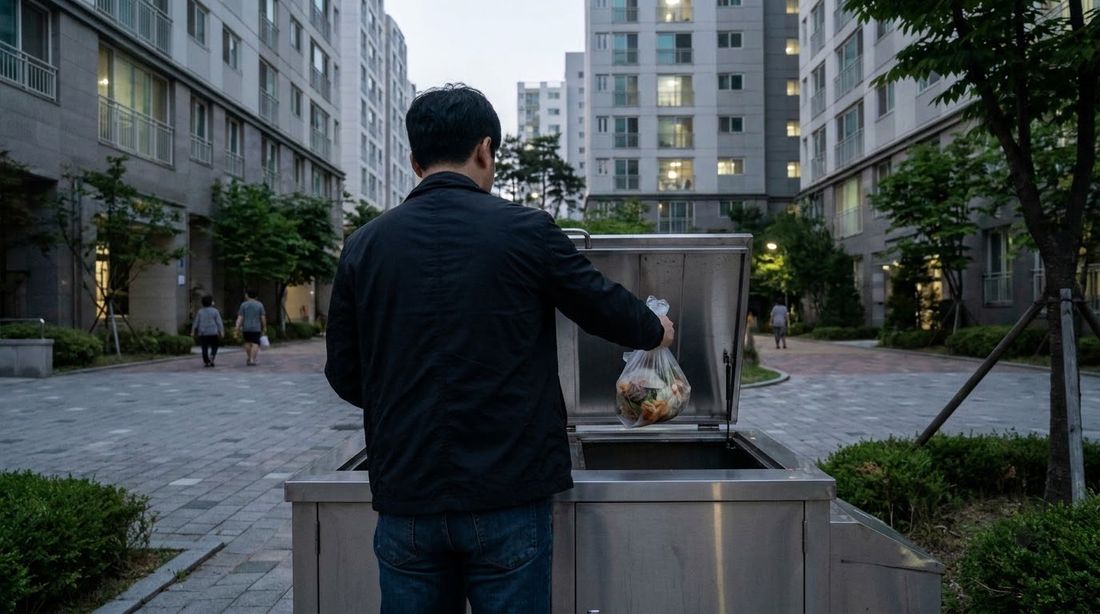
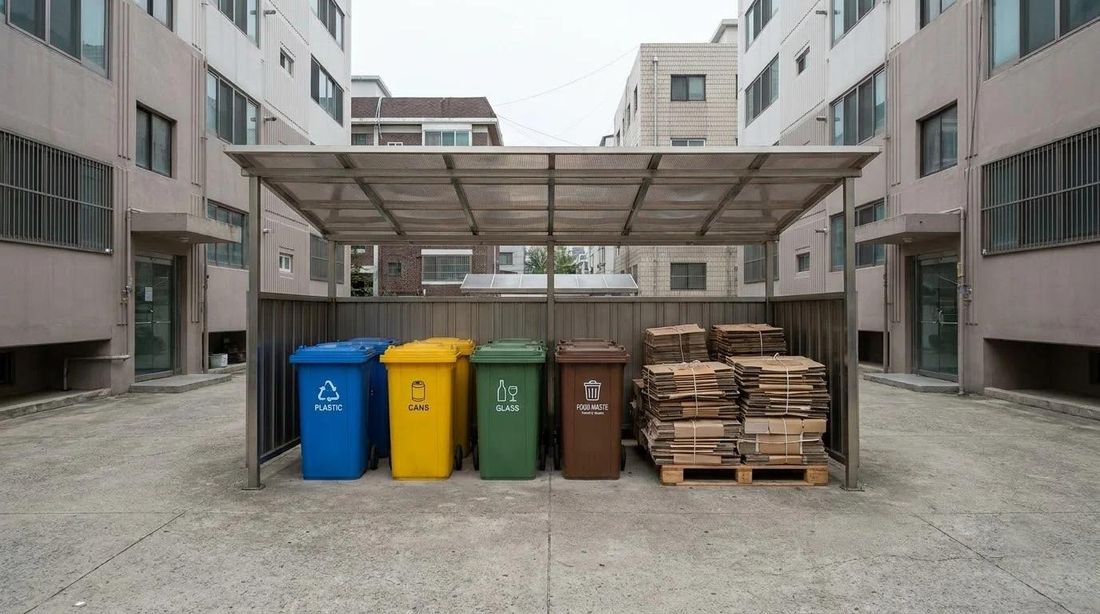
Then you separate. Paper, glass, cans, PET, other plastics, vinyl film, and — the one that surprises every newcomer — food. Food waste goes in its own container, and in a great many apartment complexes that container is a scale with a card reader on it: you tap your resident card, the lid opens, it weighs what you dropped, and it bills you for the weight.
That is unambiguously more work. Nobody enjoys it. So why does the country do it?
Because there is nowhere to put it
The answer is the same answer as every other part of this series, arriving from the other direction. Korea is small, mountainous, and has half its population — 50.8% as of 2024 — stacked inside one metropolitan region. Landfill is a solution that consumes land, and land is the thing Korea does not have.
So the exits were closed one at a time. Volume-based charging went nationwide on 1 January 1995. Direct landfilling of food waste was banned in 2005, with the capital region landfill refusing food waste from that January. Ocean disposal of the liquid pressed out of food waste was shut off in 2013 under the London Protocol. Food-waste-specific volume charging followed nationally in June of that same year, because once you cannot bury it and cannot dump it at sea, the only remaining lever is to make people generate less of it.
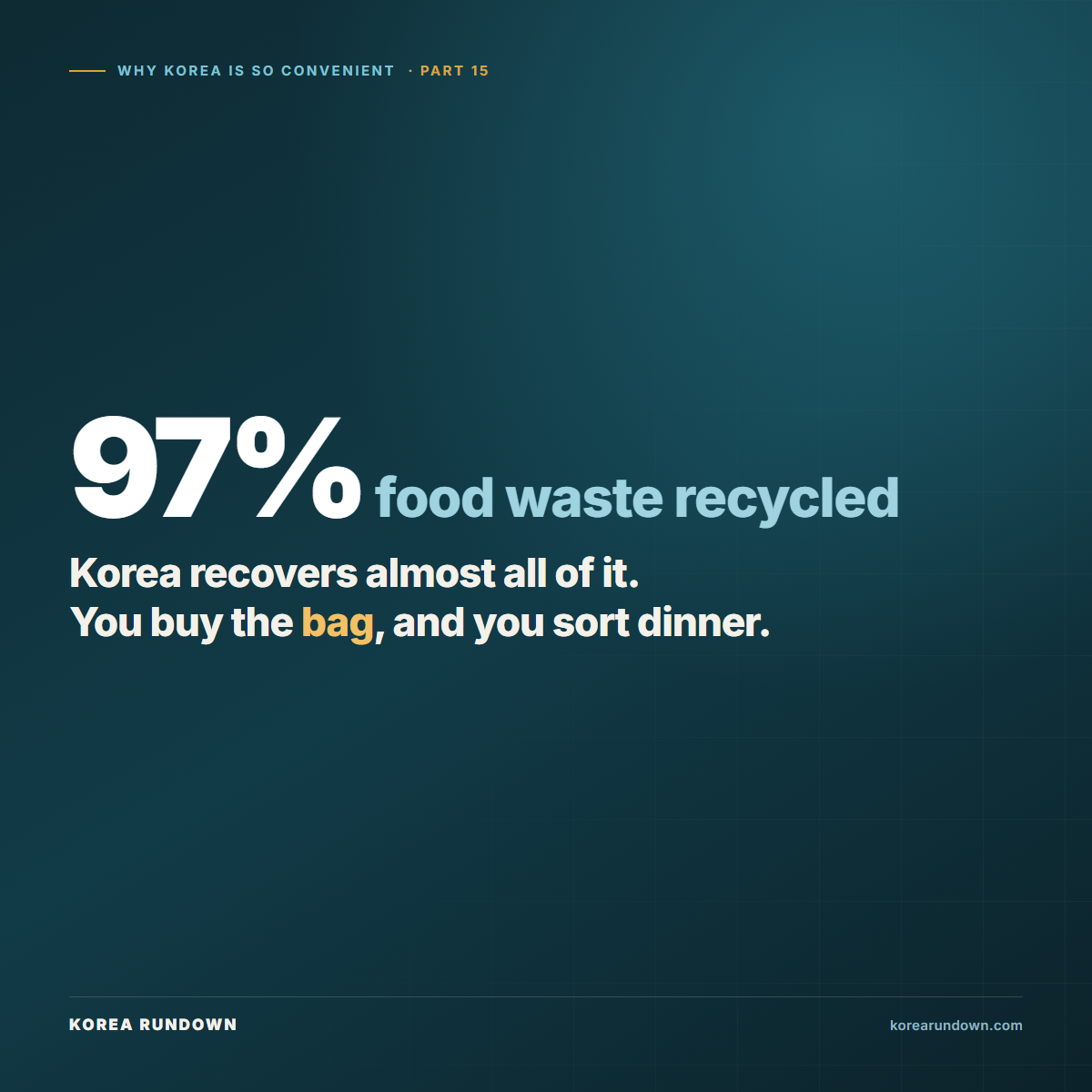
What that produced is genuinely striking. Korea recycles about 97% of its food waste into animal feed, compost and biogas — some official sources say 98%. In the United States, by EPA figures, food makes up 24.1% of everything sent to landfill, only about 5% of wasted food is composted, and wasted food accounts for 58% of landfill methane emissions.
Density made it enforceable
Charging people by volume only works if you can tell whose rubbish is whose. That is where the apartment complex earns its keep again.
In a Korean complex, several hundred households share one waste yard, one set of recycling bins, and one food-waste scale, all inside a fenced perimeter with a guard post and cameras. Every resident already carries a card that opens the lobby door. Bolting a weighing sensor and a card reader onto a bin in that setting is a small, cheap change to infrastructure that exists anyway.
Now imagine per-household weight-based food waste billing across a subdivision of detached homes on quarter-acre lots. You need a scale at every curb, or a weighing truck with per-house identification, or an inspector. The same policy that costs a Korean complex one card reader per building costs an American county a fleet. A policy nobody would attempt at low density becomes routine at high density — convenient when it is a courier drop, inconvenient when it is weighing your dinner scraps.
The honest part
The Korean system is not the triumph the 97% makes it sound like, and there are three reasons to be careful with it.
First, recycled is not the same as used. Reporting on the compost produced from Korean food waste has put actual utilization at about 49.8% — roughly half the compost finds a field. Turning waste into a product nobody buys is recovery on paper before it is recovery in fact.
Second, the volume actually went up. Korean food waste generation was reported at 21,065 metric tons a day in 2019, about 31% higher than the 16,032 metric tons a day of 2013 — that is, higher after the food-waste charging scheme went national. Charging changed where the waste goes far more than it changed how much there is.
Third, the comparison in that chart is not clean, and we would rather say so. Korea reports the share of separately collected food waste that is processed into feed, compost or energy. The EPA reports the share of all wasted food, including what is never separated at all, that is composted. They are different denominators. Korea recovers vastly more of its food waste than the United States does under any method — but do not read 97 against 5 as a like-for-like ratio.
One more thing worth saying plainly: the bag is cheap. At about 36 cents for 20 liters, the price is a nudge, not a real economic signal, and Korean commentary on the scheme’s thirtieth anniversary in 2025 has focused precisely on that — that fees no longer cover treatment costs. The system works mostly because it is a visible, enforced routine, not because the money hurts.
What density actually buys you, and what it costs
The honest summary of this series is not that Korea is convenient. It is that when you compress nearly fifty-two million people into a small, mountainous country and stack most of them in towers, some costs fall dramatically and some costs move onto the individual.
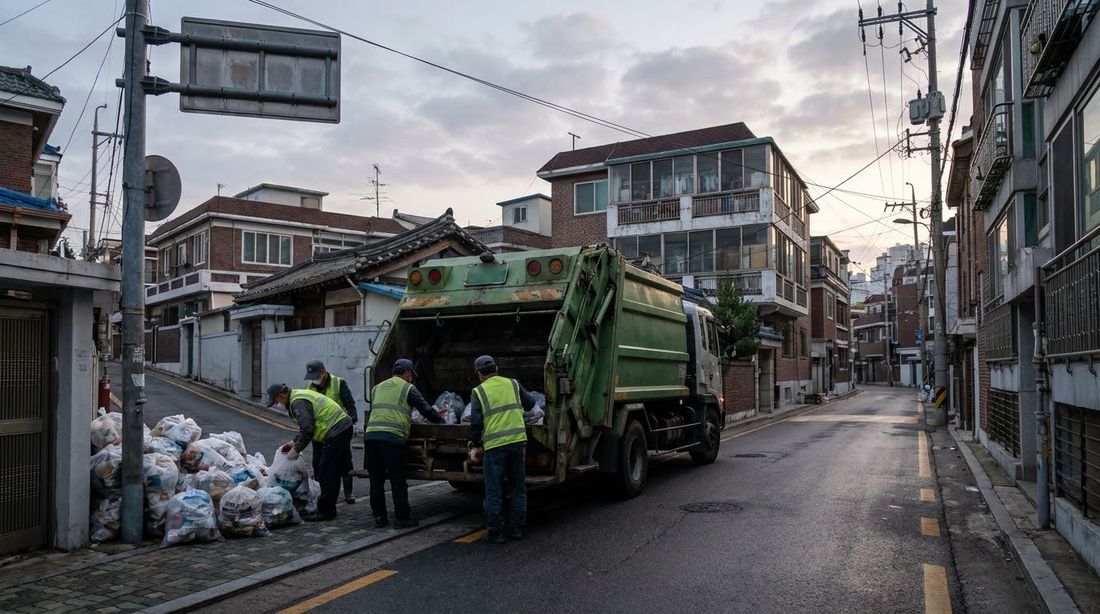
The courier, the restroom, the clinic and the subway ride get cheaper because the fixed cost is shared across an enormous number of users. The garbage gets harder because the country ran out of places to put it and had to hand each household a share of the sorting. Both are the same fact. You do not get to choose the half you like.
This is part 15 of a series on why daily life in Korea feels so frictionless. Part 14 explained the unattended laptop. Earlier parts are here.
Next in this series: the apartment complex itself — the answer these fifteen parts have been circling.


Comments
Post a Comment