Korea Taxi Price: Why a Seoul Taxi Starts at 4,800 Won at Any Hour
You open the app. Three miles across town, the number says $31. An hour ago the same trip was $14, and you have no way of knowing what it will be when you need to come back. So you stand on the sidewalk refreshing the screen, which is a strange way for an adult to spend a Tuesday.
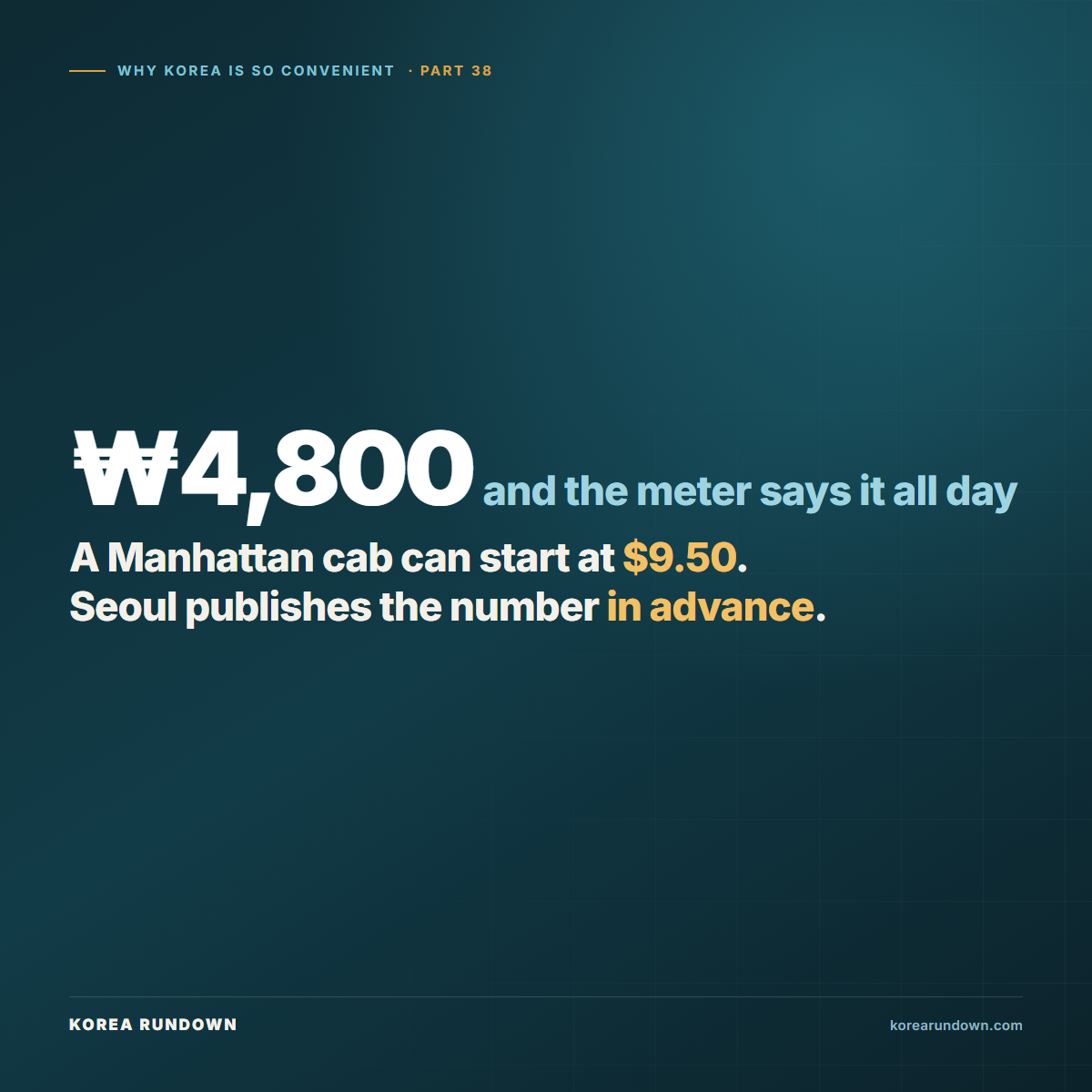
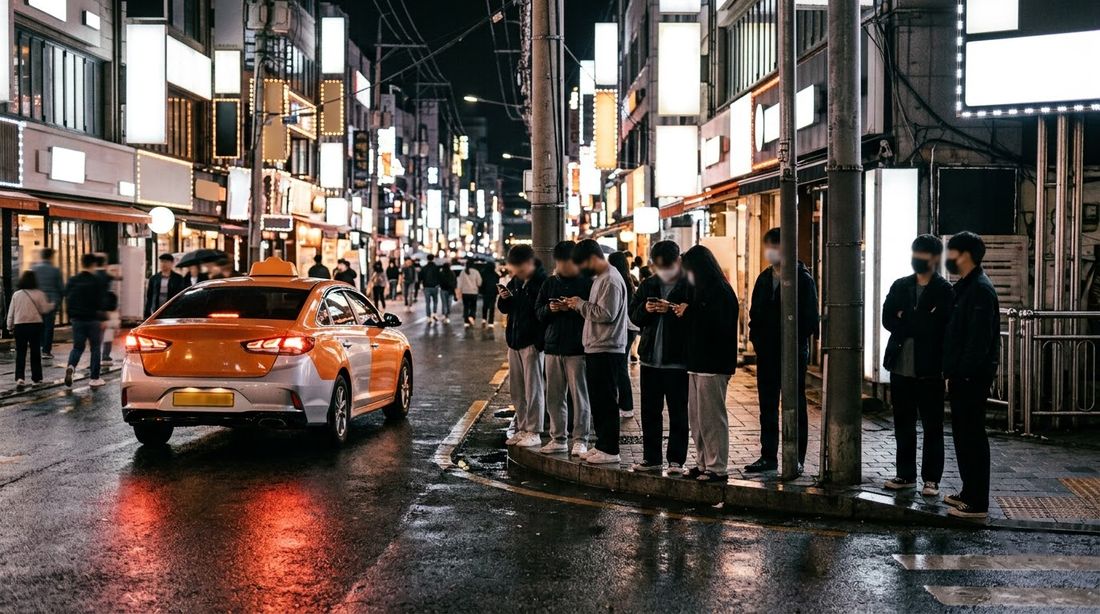
Get into a taxi in Seoul and the meter reads 4,800 won. It read 4,800 won at noon. It will read 4,800 won at six in the evening, and at eight, and at nine fifty-nine. There is no screen to refresh, because there is nothing that could have changed.
The usual guess is that Korea has so many more taxis that prices never spike. That guess is wrong in a way worth walking through.
The fare is a published table, not an outcome
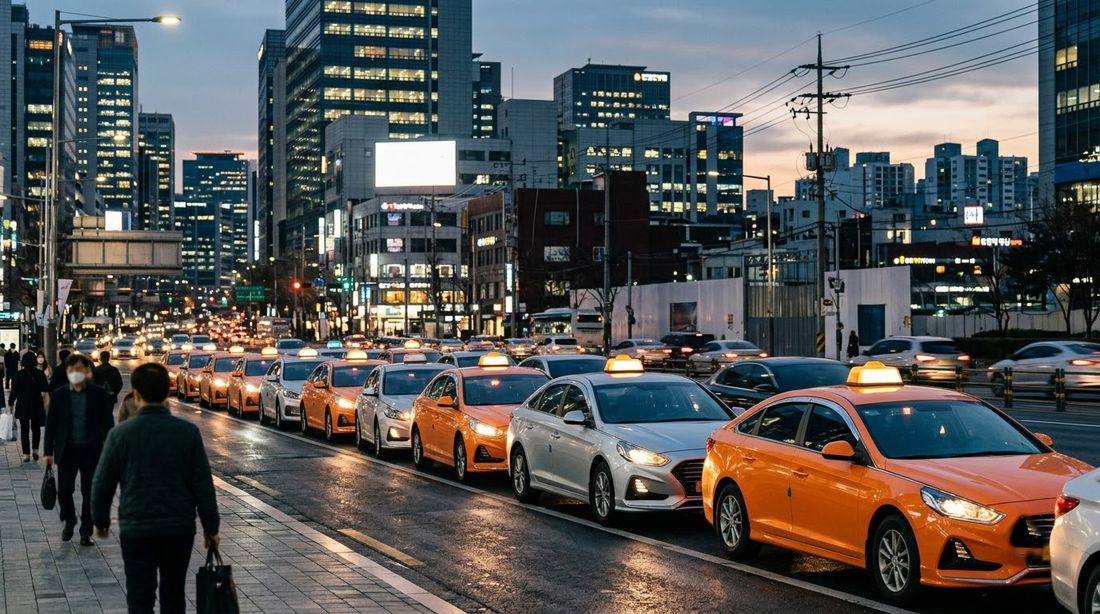
Seoul's metropolitan government publishes the taxi fare the way it publishes a bus schedule. For a mid-size taxi — 92.8% of the city's fleet — the base fare is 4,800 won for the first 1.6 kilometers, then 100 won per 131 meters, or 100 won per 30 seconds when the car is crawling below about 15.7 km/h.
Late nights carry a surcharge, and the surcharge is also a published number rather than a live one: 20% from 10 p.m. to 11 p.m. and again from 2 a.m. to 4 a.m., 40% in the three hours between. At the worst hour of the worst night, a Seoul base fare is 6,700 won. You can know that before you leave the house, in March or in December.
New York's number is not one number
A yellow cab in New York starts at a $3.00 initial charge plus 70 cents per fifth of a mile. Then the additions begin. A $1.00 improvement surcharge on every trip. A 50-cent state surcharge. A $2.50 state congestion surcharge on anything that begins, ends or passes through Manhattan below 96th Street. A $1.00 overnight surcharge from 8 p.m. to 6 a.m. A $2.50 rush hour surcharge from 4 p.m. to 8 p.m. on weekdays.
Stack the weekday-evening Manhattan case and the meter is at $9.50 before the wheels turn. Each component is public and fixed, so this is not hidden pricing. It is five separate decisions arriving as one number, and no rider does that sum in their head.
It is not that Korea has more cars for hire
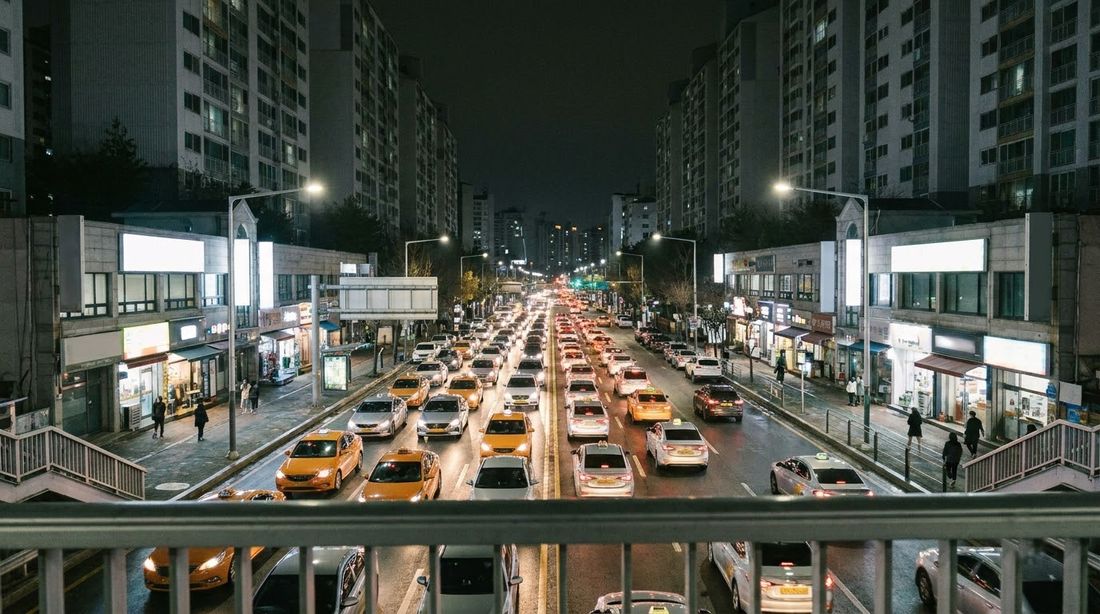
Seoul licenses 71,615 taxis as of January 2026 — 49,048 owner-operated and 22,567 run by companies.
New York licenses 13,587 medallion taxis, which sounds like a rout until you add the rest. The Taxi and Limousine Commission licenses more than 120,000 vehicles in total, most of them for-hire vehicles dispatched by app. By any count of cars available for hire, New York has comfortably more than Seoul.
So supply is not the variable. Both cities have plenty of cars. What differs is who is allowed to set the price when demand moves — a metropolitan government publishing a table in advance, or a dispatch algorithm reading the market in real time. Korea's convenience here is not abundance. It is a decision about pricing authority.
The honest part: the table has costs, and Koreans pay them
Three things cut against the tidy version.
First, the fleet is not all working. Of those 71,615 licenses, 64,933 are registered vehicles, and 5,483 sit on suspended operation. A licence is not a car on the road, and the gap is around seven thousand cars.
Second, a fixed price cannot clear a market on its own, and it does not. Late night is exactly when a Seoul taxi is hardest to find, which is the predictable result of holding the price near flat while demand triples. The 40% surcharge is the government's attempt to do with a blunt instrument what surge pricing does with a sharp one, and it does not fully work.
Third, the price stability people enjoy is stability between the jumps. The current fare came in on 1 February 2023, and it arrived as a single step from 3,800 won to 4,800 won — a 26% increase overnight. A published table does not mean a gentle one. It means the pain is concentrated on one date instead of spread across a thousand evenings.
Where the density comes in
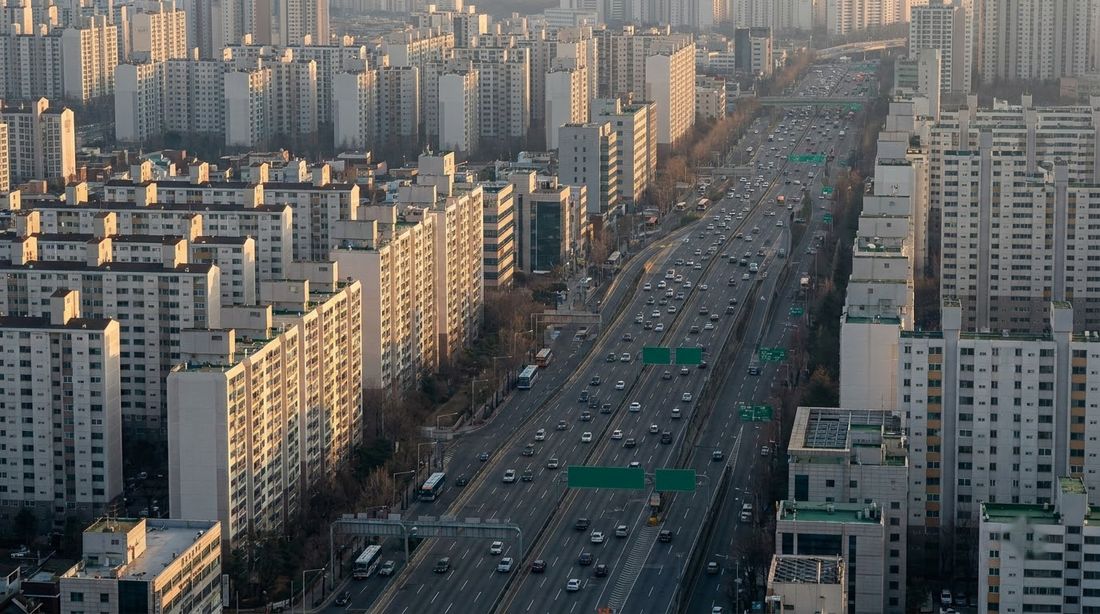
A fixed meter is only survivable for the driver if the car refills quickly. That is the whole hinge. Drop a passenger in central Seoul and the next fare is usually within sight; the empty kilometers between paid ones are short, so an average that works on paper also works on a shift.
Stretch the same number of rides across a metro area built at a quarter of the density and the empty kilometers grow. Now the flat rate that fed a driver in the dense city starves one in the sprawling one, and the only ways out are to raise the base fare for everybody or to let the price float with demand. American cities chose the second, which is why the number on your screen moves.
Neither city decided this out of national character. They decided it out of how far apart the passengers stand.
This is part 38 of a series on why daily life in Korea feels so frictionless. Part 37 looked at why a country with fewer libraries per person is the one where people walk to them. Earlier parts are here.
Next in this series: another piece of ordinary Korean infrastructure whose price turns out to be set by how many people are standing within a few hundred meters of it.


Comments
Post a Comment