Korea Counted 78,183 Public Restrooms. America Has About 8 Per 100,000 People.
You are downtown and you need a bathroom. Not urgently, not yet. So you start the routine: the coffee shop where the door has a keypad and the code is printed on a receipt you have to buy something to get; the department store where the restroom is on the sixth floor behind the furniture; the gas station with the key on a wooden paddle; the park building that was locked in 2020 and never reopened. Somewhere in there you stop treating it as a small logistical problem and start treating it as the thing organizing your afternoon.
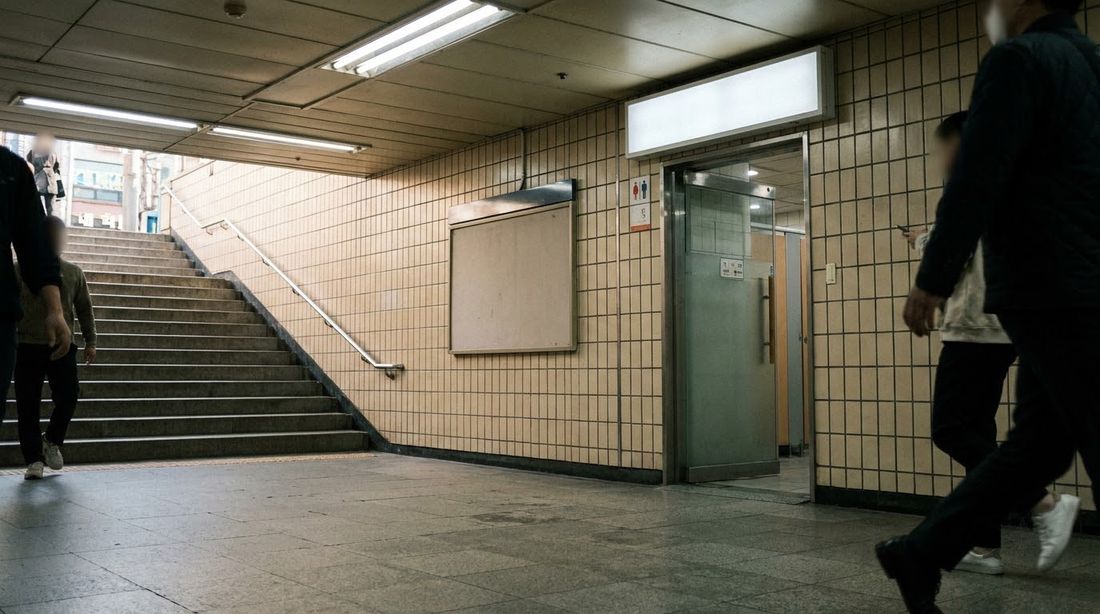
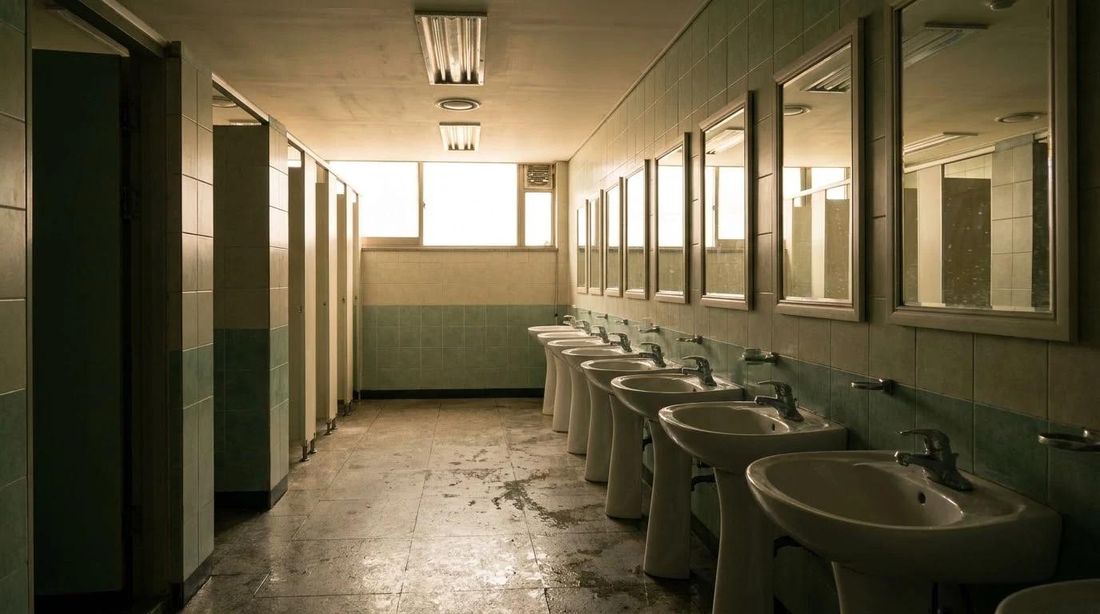
In Seoul the same problem is usually solved by walking into the nearest subway station, which has a restroom past the gates, or before them, and no code. If there is no station, the next option is a public building, a park, or a shop that has a small green sticker on the door saying its restroom is open to anyone.
That sticker is the interesting part, and it is not a courtesy. It is a legal category.
Korea counts them
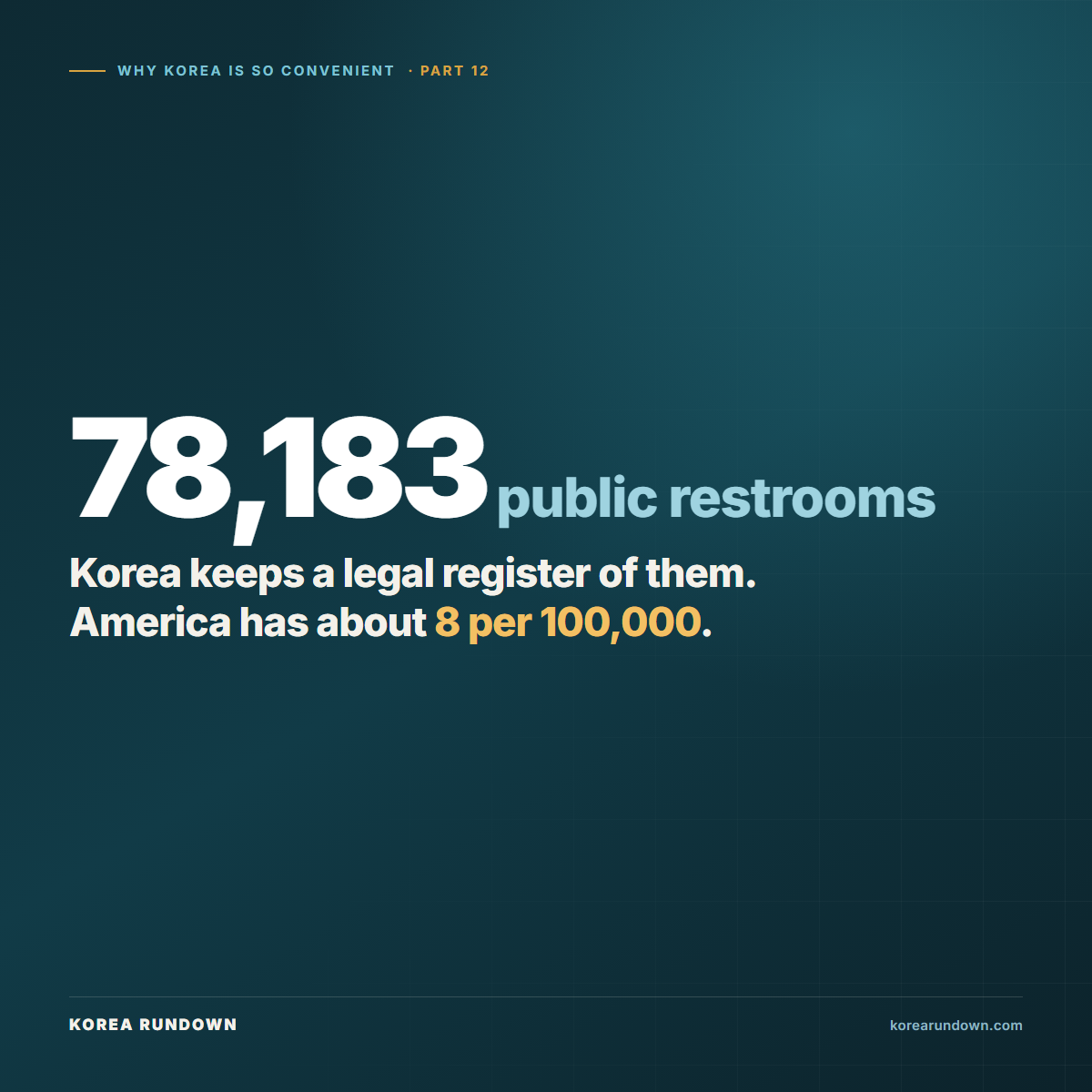
South Korea has a statute called the Act on Public Toilets, and under it the Ministry of the Interior and Safety runs a national count. The 2024 survey found 78,183 public restrooms nationwide, up 9,333 in a single year from 68,850 at the end of 2023.
Against a population of 51.81 million recorded in the 2024 census, that works out to roughly 151 public restrooms per 100,000 people.
The most-cited international comparison, the Public Toilet Index compiled by the bathroom supplier QS Supplies, puts the United States at about 8 per 100,000, ranking it 31st, below the UK at 15, Canada at 18 and Australia at 37. Within the US the spread is enormous: Salt Lake City comes out at 66.6 per 100,000 and Honolulu at 56.5, while New York City sits at 11.5 and Providence, Rhode Island at 2.6.
The mechanism: a restroom that belongs to a shop but is legally open
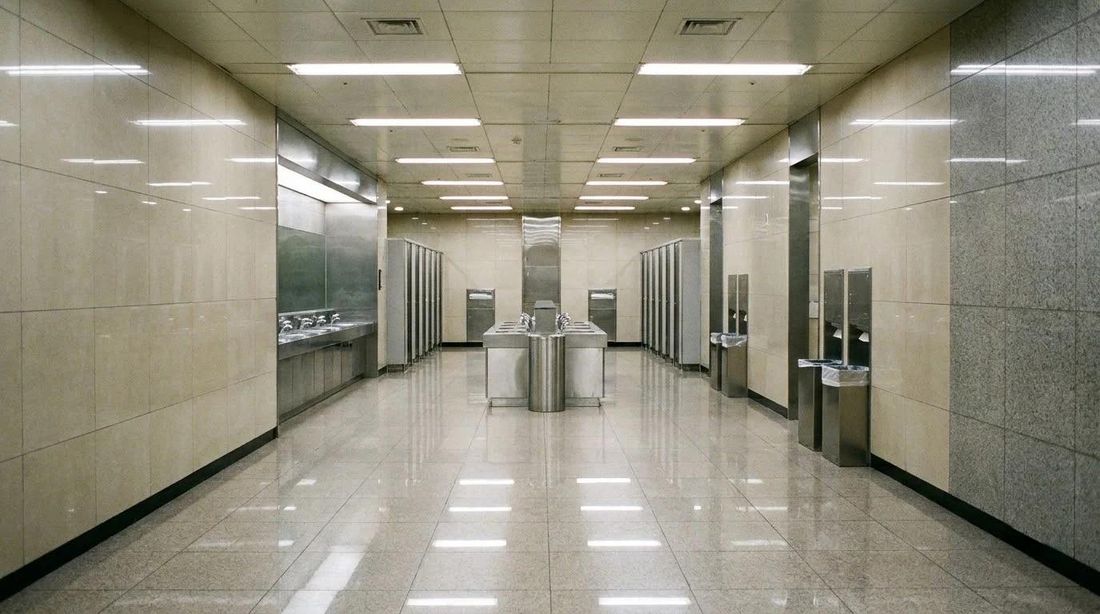
The Korean law defines two things. One is an ordinary public toilet, built and run by the government. The other is the open restroom — and its statutory definition is a restroom inside a public agency facility that has been opened for public use, or a restroom that the local mayor, county head or district head has formally designated as open. The same act lets local governments pay subsidies to people who install, manage or improve public restrooms.
So a privately owned restroom in the back of a small building can be brought into the public network by a designation from the district office, with public money helping cover what that costs the owner. The green sticker is the visible end of that arrangement.
This is a different solution from the American one, which is essentially to have no solution. In most US cities the restroom question is delegated entirely to private businesses, who then face the cost alone, and who respond exactly as you would expect someone facing a cost alone to respond — with a keypad, a purchase requirement, or a locked door.
Why Korea can afford the density
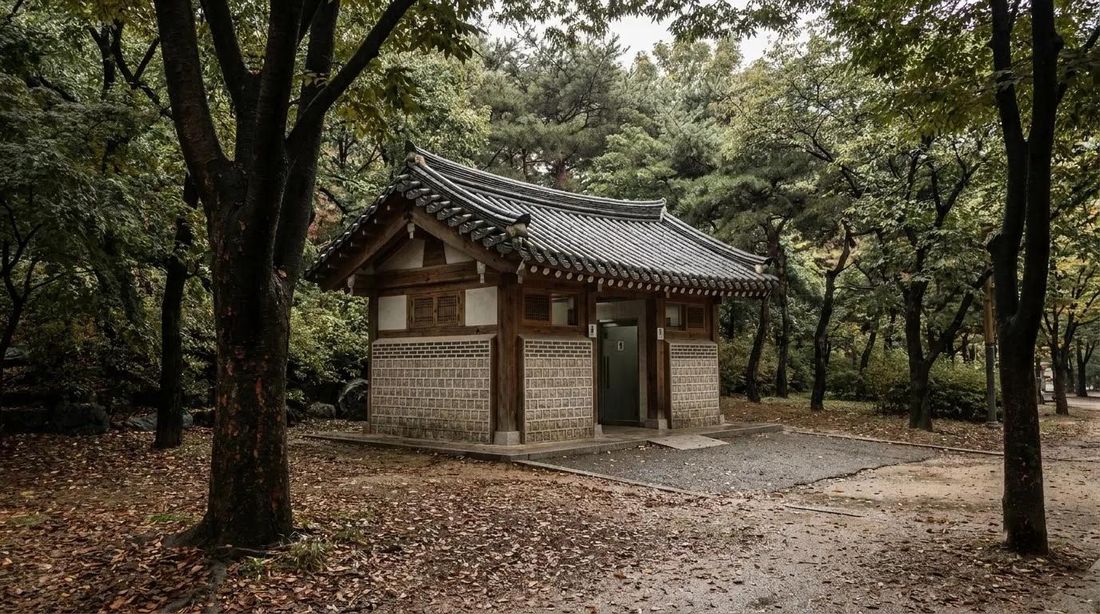
A restroom is a fixed cost that has to be paid whether one person uses it or four hundred do. Its cost per use collapses as footfall rises.
Seoul packs roughly sixteen thousand people into every square kilometre, and its subway stations sit under commercial streets that thousands of people cross on foot in an hour. A restroom in that station is amortised across an enormous number of visits. A restroom in a park-and-ride lot in a low-density American suburb is amortised across very few, and every dollar of its cleaning contract shows up per user.
Add the vertical building pattern. In Korea a single commercial block routinely holds a dentist, a study room, two restaurants, a hair salon and a cram school, all sharing one restroom per floor that everyone in the building already uses. Designating one of those as open costs the owner very little, because it was going to be cleaned anyway. In a strip mall where each unit has its own restroom behind its own counter, the same designation means a stranger walking through your shop.
The honest part
Three things need saying.
First, the comparison in the chart is not apples to apples, and we would rather tell you than let you find out. Korea produces its figure through a legally mandated government census that includes designated private restrooms. The international index is compiled from mapping data and does not have a statute behind it. Korea would look better than the United States on any honest method, but the exact ratio between 151 and 8 is doing more work than the underlying data can bear.
Second, quantity is not quality. Korean public restrooms range from spotless, heated, and better appointed than most American hotel bathrooms, to genuinely unpleasant older facilities in bus terminals and mountain parks. The 2024 count is a count, not a review.
Third, the serious problem. Hidden-camera crime in restrooms has been a real and widely reported issue in Korea, and it is one reason districts now run inspection programs and seal suspicious holes in stall partitions. Part 6 of this series covered the same crime category in its own right. A country with a restroom on every corner also has more corners to police, and pretending otherwise would be dishonest.
What density actually buys you
The bathroom is not free. Someone pays for it either way. The difference is that when thousands of people pass a fixed point every hour, the cost per person of a clean toilet at that point falls low enough that a government will carry it, and low enough that a shop owner will accept a subsidy to share theirs.
Spread the same people over forty square miles of driveways and the arithmetic stops working, and the keypad on the coffee shop door starts to look less like rudeness and more like the only answer available.
This is part 12 of a series on why daily life in Korea feels so frictionless. Part 11 asked why couriers can leave six billion parcels on the floor. Earlier parts are here.
Next in this series: 1,208 government documents you can issue from your phone — and the week America queued at the DMV.


Comments
Post a Comment