Korea Leaves 5.9 Billion Packages on the Floor Outside Your Door. Almost None of Them Vanish.
The notification says Delivered. You are at work. For the next six hours a cardboard box with your name on it is sitting on a concrete step that faces a public street, and there is nothing between it and anyone who walks past. So you do what everyone does now. You ship to the office. Or to a locker in a parking lot four miles away. Or you pay for a doorbell camera, so that when the box does disappear you at least get footage of the person carrying it.
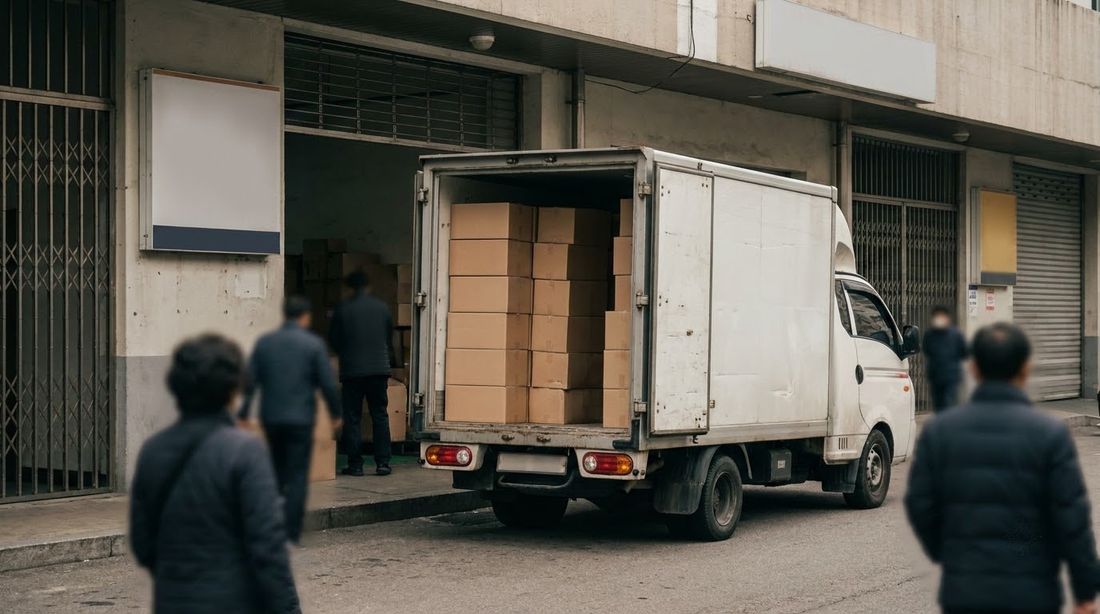
Security.org, which has tracked this annually for years, estimates that about 37 million packages are stolen in the United States in a year — roughly 101,000 a day, worth around $8.2 billion, with the average stolen parcel valued at about $222. One in four Americans has had a package taken at some point.
In Korea the box gets left on the floor outside your door, and often it stays there until you get home. Sometimes overnight. Sometimes for two days if you are traveling. The usual explanation offered for this is that Koreans are unusually honest. That explanation is doing almost none of the work.
The scale first, because it is the part people get wrong
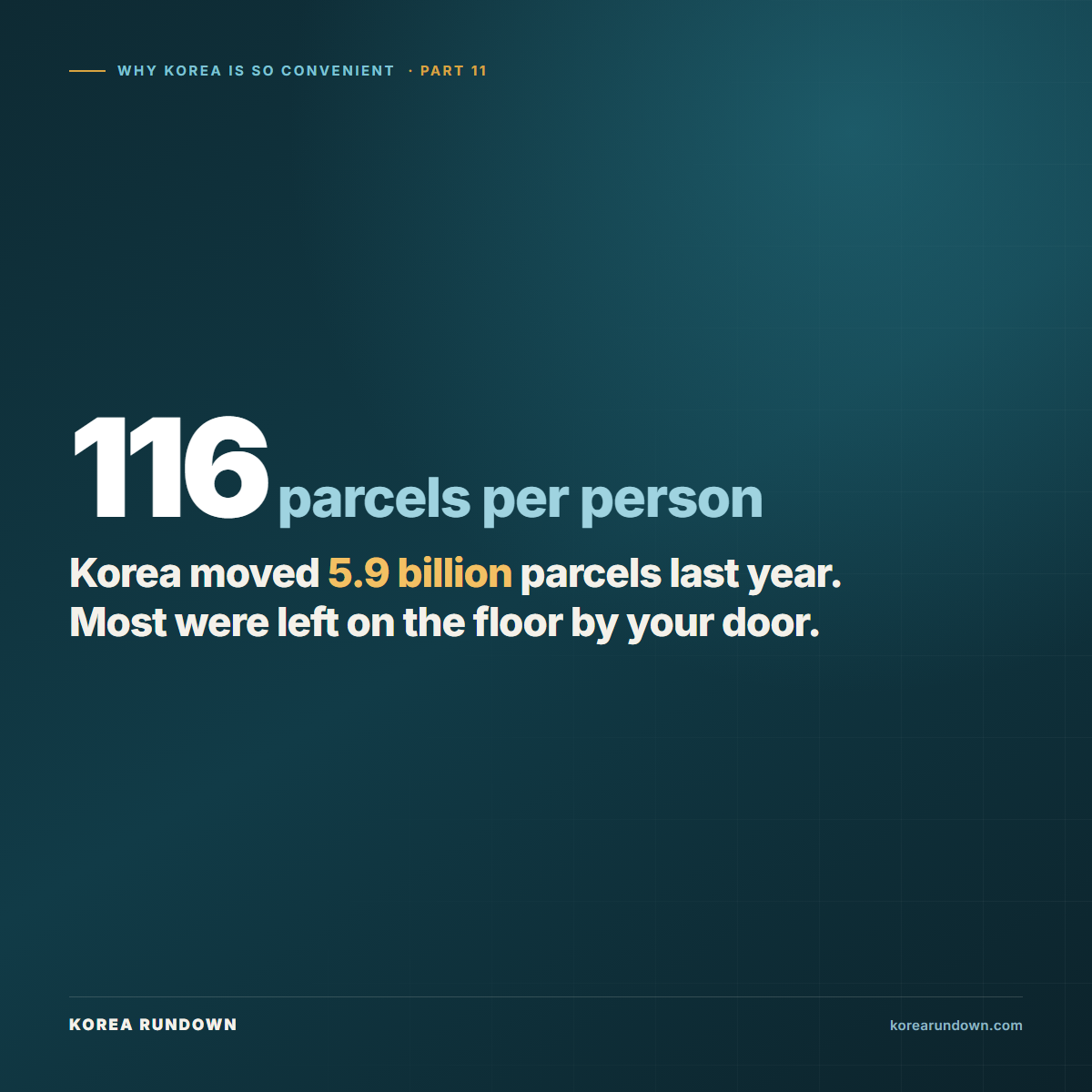
South Korea is not a low-volume delivery country where parcels are rare enough to go unnoticed. It is close to the opposite. The National Logistics Information Center recorded 5,956,340,000 parcels moved in 2024, up about 15% on 2023. Per head that is 116.3 parcels a year — one every three days for every person in the country, infants included. Industry watchers expect 2025 to clear six billion.
The average price paid to move one of those boxes was about ₩2,351, or roughly $1.70 at the late-August 2026 rate of about ₩1,378 to the dollar. That is a national average across all shippers and all box sizes, not a promotional rate.
The door is not on the street
Here is the structural answer, and it is dull in the way structural answers usually are.
In the United States the standard delivery target is a front door that opens onto a public sidewalk. Anyone can approach it without passing through anything. The box is exposed the moment the driver walks away, and the driver has to get back to a van at the curb, which is why the drop is fast and unattended.
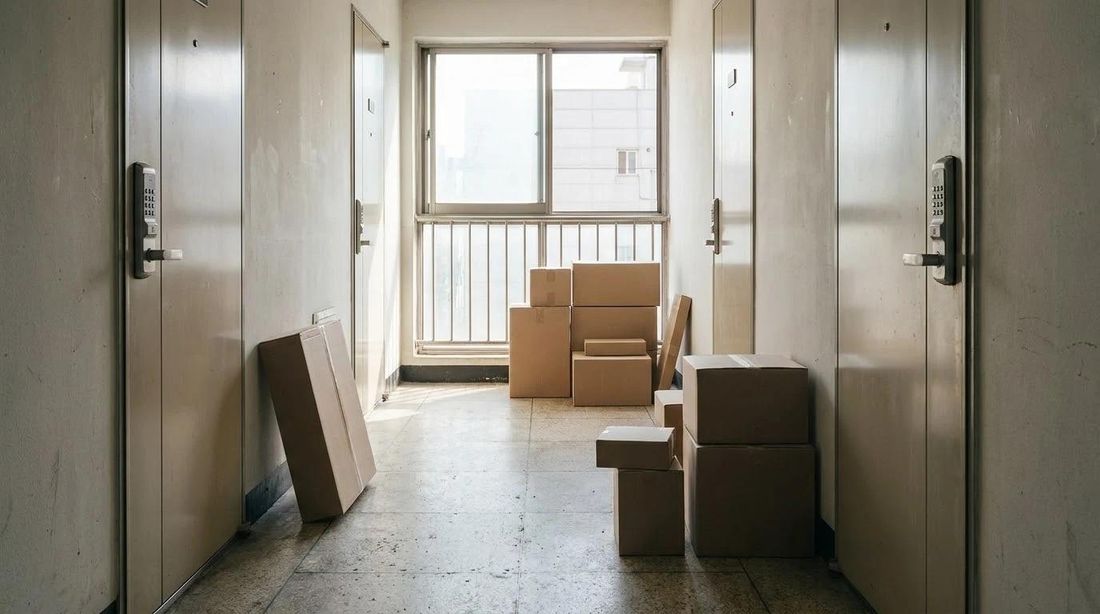
In Korea the standard delivery target is a door on the eleventh floor of a residential tower. To reach it the driver passes through a shared entrance, usually one that needs a code or a resident to buzz them in, and then takes an elevator. The corridor outside your door is not a street. It is an interior hallway that a stranger has to get through a locked lobby to reach, in a building with a guard post at the vehicle entrance and cameras in the lift.
So the box is not really lying in the open. It is lying inside a perimeter. That perimeter was not built to protect parcels — it exists because the building stacks several hundred households on one lot and has to control who comes in. Parcel security is a side effect of vertical housing.
The same geometry explains the price. A Korean courier who parks once can serve two or three hundred doors without moving the van, riding up and down with a hand cart. An American courier serving two hundred doors drives between two hundred driveways. That difference is most of why one box costs about $1.70 to move here.
The honest part
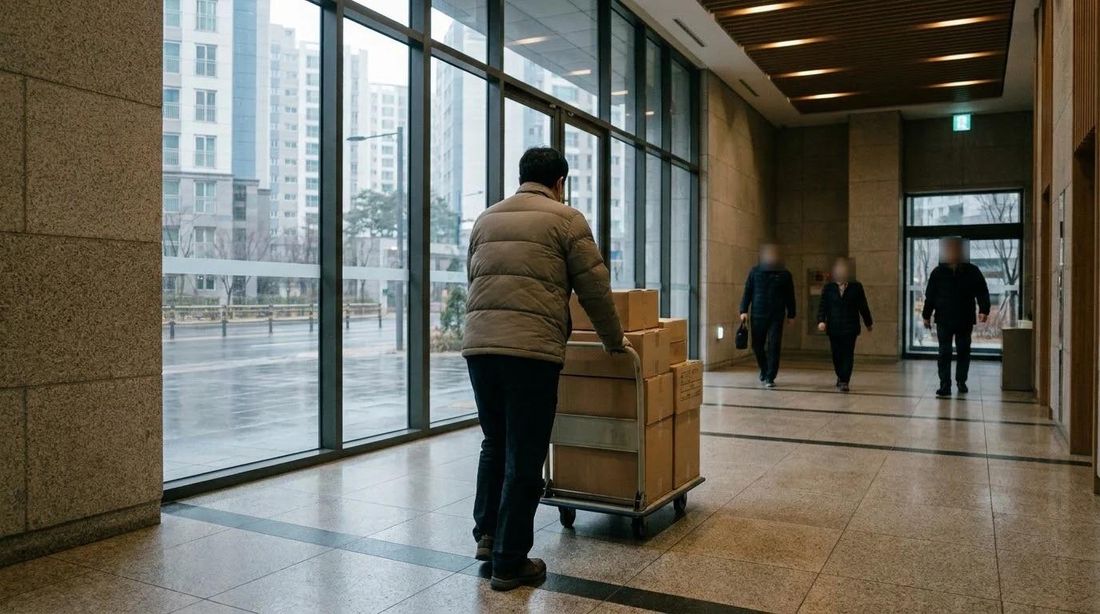
Parcel theft in Korea is not zero, and the complaint numbers are moving the wrong way. The Korea Consumer Agency logged 1,209 consumer complaints about parcel and freight services in 2024, up 33.4% on 2022. Korean media run doorstep-theft stories every winter, and buildings have responded by installing unattended parcel lockers in lobbies — which is itself an admission that the open floor drop is not universally safe.
One thing we could not verify: there is no published police statistic that isolates parcel theft in Korea. It sits inside general small-value larceny, so nobody can honestly hand you a Korea-versus-America theft rate for packages specifically. Anyone who quotes you one has either invented it or compared two different definitions. We are leaving the number out rather than guessing.
And the cheap box has a cost that is not paid at the counter. The rate is that low partly because courier work in Korea has been punishing — something the country argued about in public after a run of overwork deaths among delivery drivers, which produced a 2021 social agreement on hours and sorting duties and pushed unit prices up. The convenience is real. It was not free, and the people who absorbed the cost were not the customers.
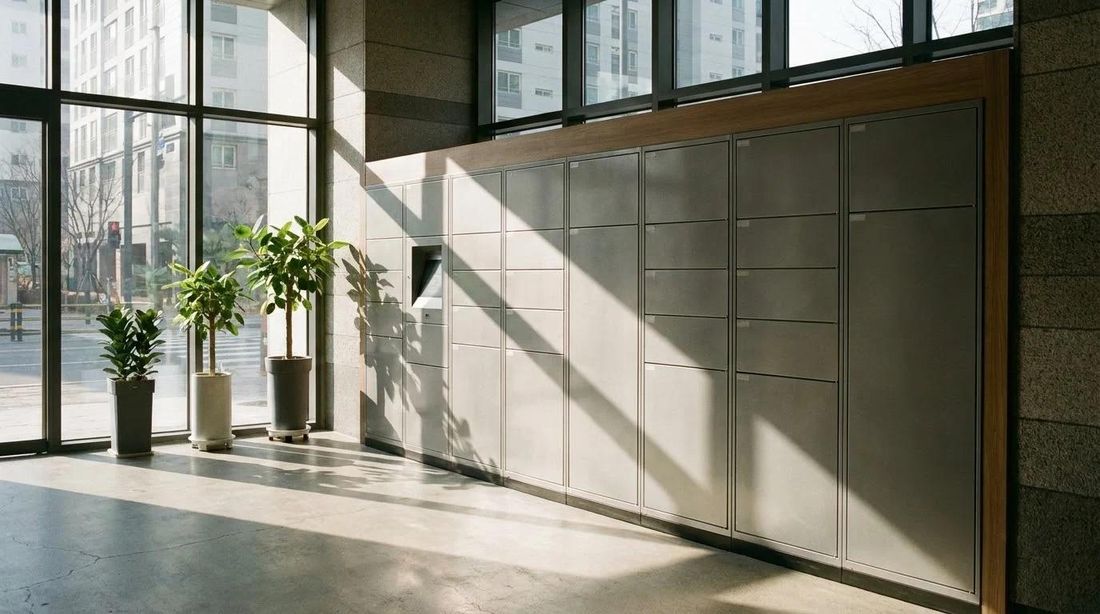
What density actually buys you
Take the tower away and every advantage here collapses. Without the shared locked lobby the box is exposed. Without three hundred doors inside one elevator shaft the drop cost triples. Without the guard post and the interior corridor, leaving a parcel out for a day is reckless rather than normal.
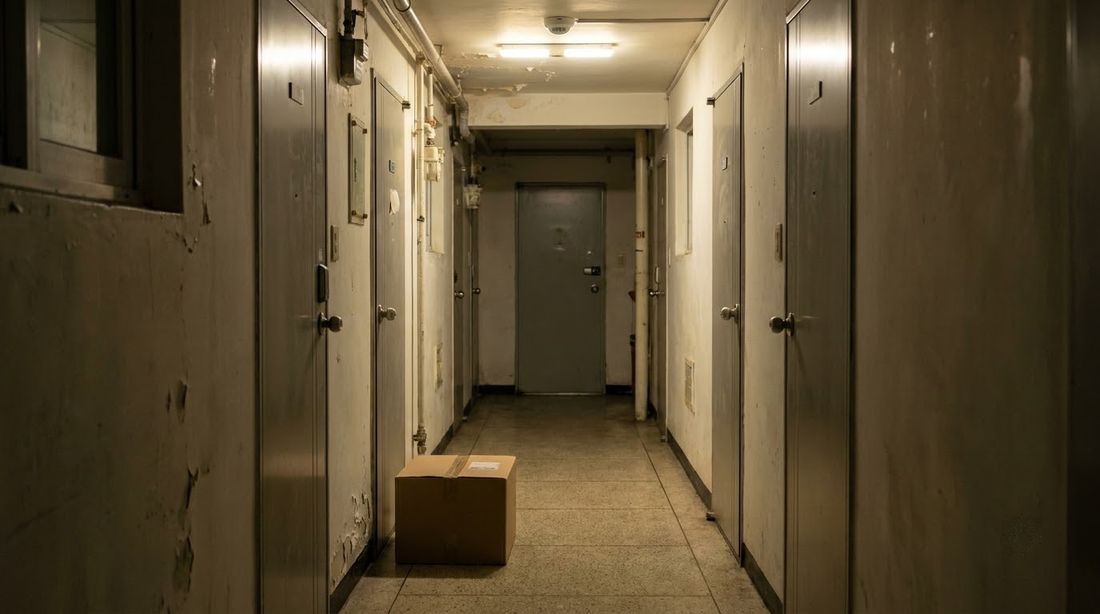
None of that is a national character trait. It is what happens when the average home is one door among hundreds behind a single controlled entrance, and the last hundred meters of the supply chain runs through an elevator instead of a driveway.
This is part 11 of a series on why daily life in Korea feels so frictionless. Part 10 looked at the two statutes that decide whether a shop can refuse your card. Earlier parts are here.
Next in this series: why Korea counts its public restrooms — and what it means that America mostly cannot.


Comments
Post a Comment