Korea Healthcare Cost: Why a Doctor Visit Is About $6
This is part four of a series on why daily life in Korea feels so frictionless. Part three covered the subway.
You wake up with a sore throat that has gone from annoying to alarming. In much of the United States, the next thought is not medical. It is arithmetic. Is this urgent-care money? Have I hit my deductible? Is my regular doctor booked out three weeks? Is it bad enough to justify what it is going to cost?
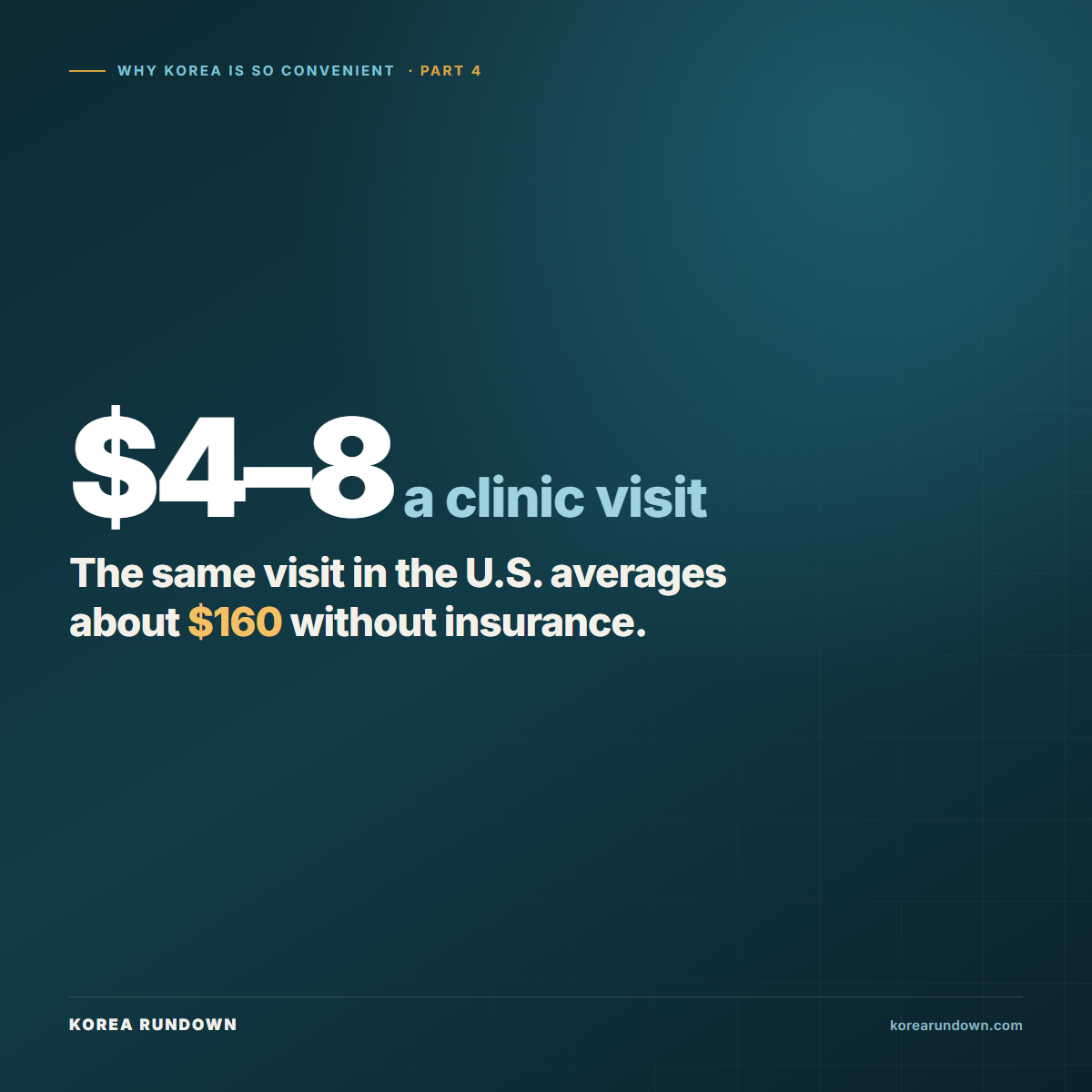
That calculation is the thing Koreans mostly do not run. You walk to a neighborhood clinic, usually without an appointment, and walk out having paid somewhere around 5,000 to 10,000 won — roughly four to eight dollars.
An uninsured primary care visit in the United States averages around $160, with a common range of about $130 to $200. An emergency room visit runs about $2,715.
Where the price actually comes from
This one is not density. It is worth being precise about that, because the rest of this series has leaned hard on population geometry and this is a different mechanism.
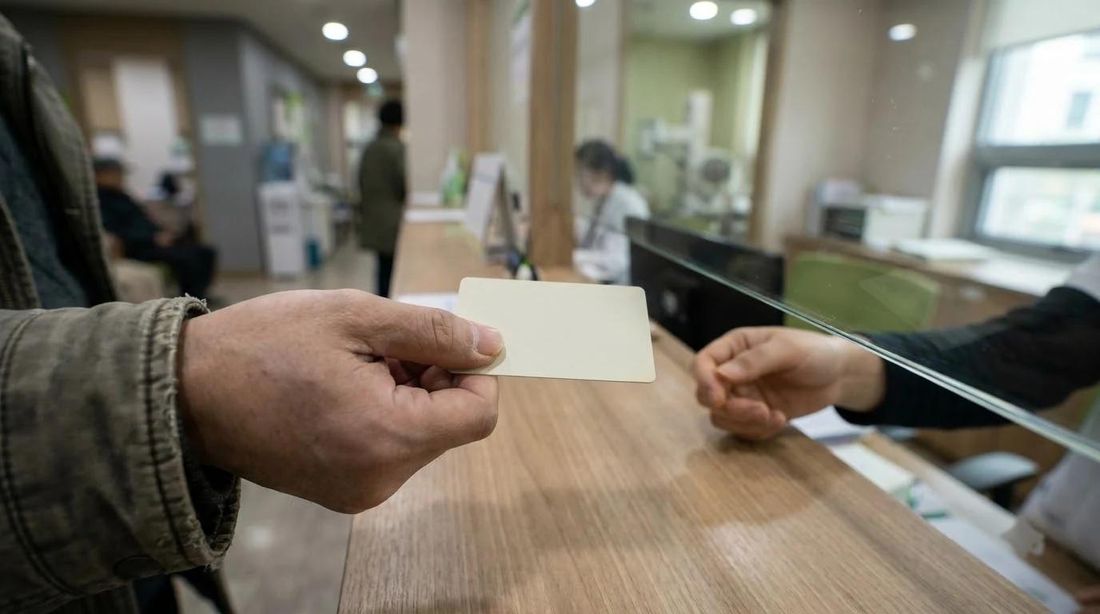
Korea runs a single national insurer. Enrollment is mandatory, the fee schedule for covered services is set nationally rather than negotiated clinic by clinic, and the patient pays a fixed share of a price that was decided in advance. At a neighborhood clinic that share is roughly 30 percent. At a larger hospital it rises to about 40 percent, and at a general hospital about 50 percent — a deliberate nudge to keep routine problems out of big hospitals.
So the six dollars is not a discount. It is 30 percent of a number the system already capped. There is no separate negotiated rate, no surprise out-of-network bill, and no meaningful uncertainty about what the visit will cost before you walk in.
Sources: Korean National Health Insurance copay structure and typical clinic costs, 2025–2026; U.S. uninsured primary care and emergency room cost surveys, 2025–2026; OECD outpatient visit comparison.
Density does show up — in the walking, not the billing
Price is the insurance system. Access is the city. Those are two different things and they compound.
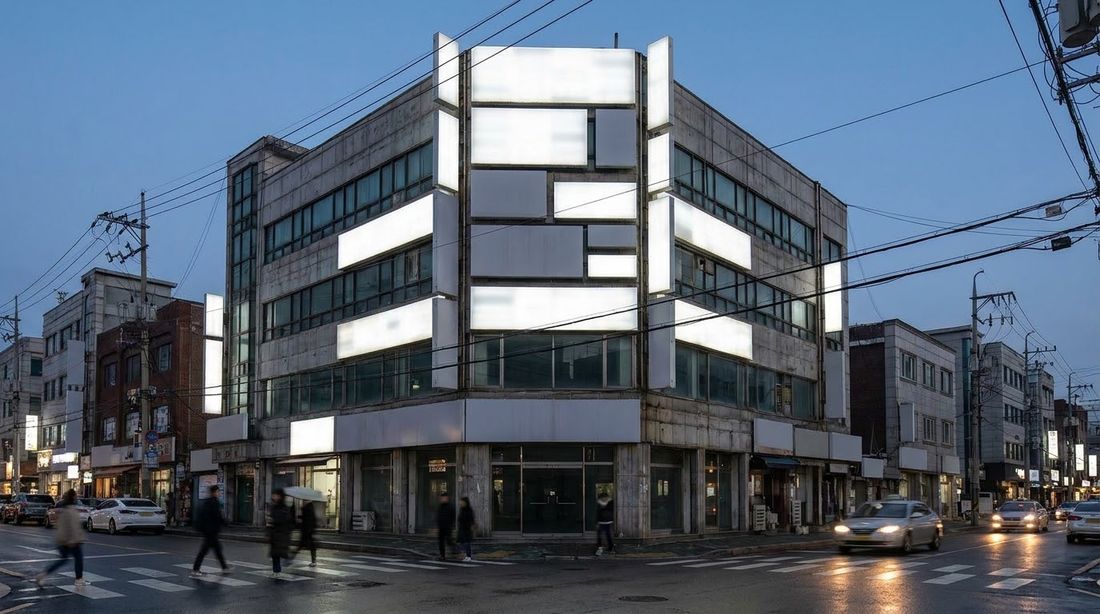
In a Korean apartment district there is usually a building near the station with a dermatologist on one floor, an ENT on another, an orthopedic clinic above that, and a pharmacy on the ground floor. You do not drive to a medical campus. You walk past it on the way home. The same density that makes a convenience store profitable on every corner makes a specialist clinic viable in a mid-rise.
Put near-zero price next to near-zero travel friction and the result is the number in the graphic above: 18 visits a year, nearly three times the OECD average. That is not a nation of hypochondriacs. It is what happens when both barriers to seeing a doctor are removed at once.
The part that is not flattering
Here is the bill for all that volume, and it comes due in two ways.
The first is the appointment itself. There is a Korean phrase for it — three hours waiting, three minutes of consultation. Observational research puts the average outpatient consultation at roughly six to seven minutes, against about 21 minutes in the United States and nine in the United Kingdom. If you want a doctor to sit with you and think slowly about something complicated, the Korean system is not built for that. It is built for throughput, and patients say so: the most common complaints are too little time and not enough chance to explain.
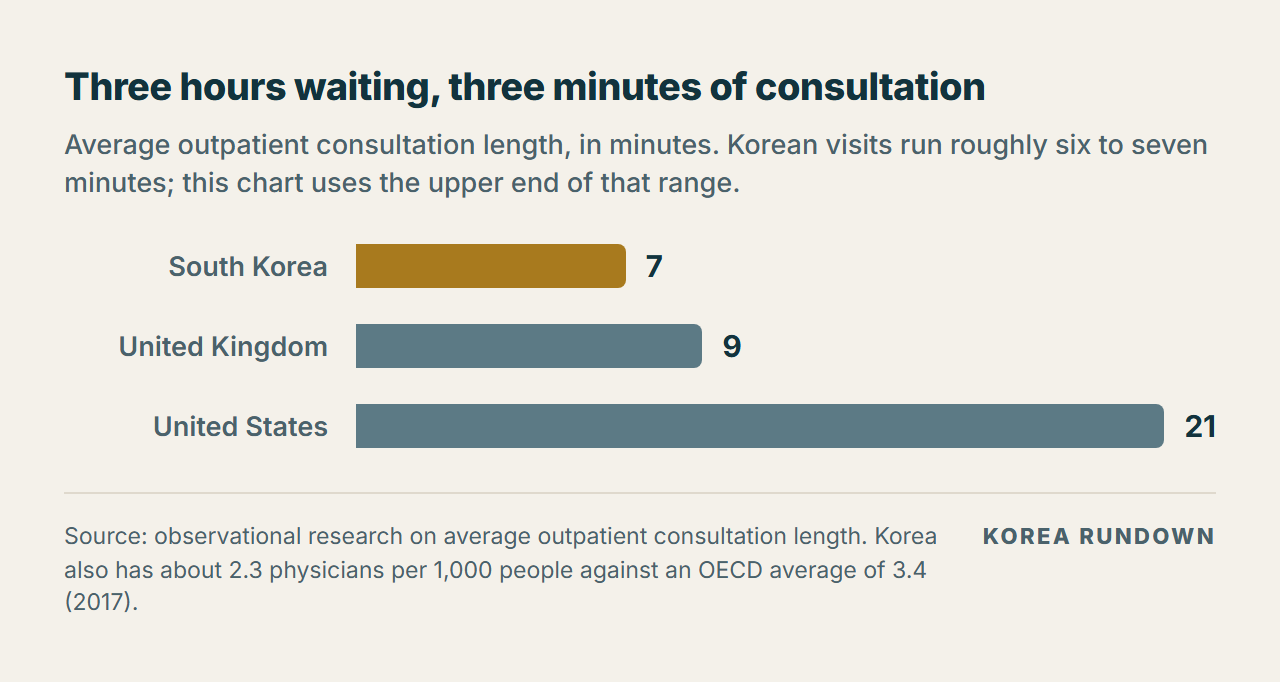
Korea also has fewer physicians per capita than the OECD average — about 2.3 per 1,000 people against an OECD average of 3.4 in 2017 figures. Those short visits are partly what makes 18 visits a year physically possible with that workforce.
The second is the money. The insurer is running into demographics. Korea is aging faster than almost anywhere, and published projections have the national insurance fund tipping into deficit in the mid-2020s with reserves drawn down over the following years. Contribution rates rise most years. None of this means the system collapses tomorrow, but the six-dollar visit is not a permanent fact of nature. It is a policy that has to keep being paid for by a shrinking share of working-age contributors.
The comparison people actually want to make
It is tempting to end here with a verdict about which country treats its sick people better. That is not really what the numbers support.
What they support is narrower and more useful: the two systems optimize for different things. Korea has driven the cost and friction of a routine visit to almost nothing, and pays for it in consultation length, physician workload, and a financing problem arriving with the demographics. The United States spends far more per encounter and delivers longer visits to the people who get in the door, while the price itself deters a large number of people from going at all.
The part worth envying is not the six dollars by itself. It is that nobody in Korea has to decide whether a sore throat is worth the money.
Next in this series: the thing Americans notice within about a day of arriving and struggle to explain to people back home — walking around a major city at two in the morning without thinking about it.


Comments
Post a Comment