Internet Cost in Korea per Month: Why 1 Gigabit Runs About $28
The bill arrives and it is nine dollars higher than last month. Nothing changed. You did not upgrade anything. Somewhere in the fine print a twelve-month promotional rate ended, and the real price — the one that was always going to arrive — has now arrived. There is a $15 equipment rental line for a modem you have had for four years. There may or may not be a second provider available at your address; for a lot of American households there is exactly one, which makes the annual phone call about the rate less of a negotiation than a request.
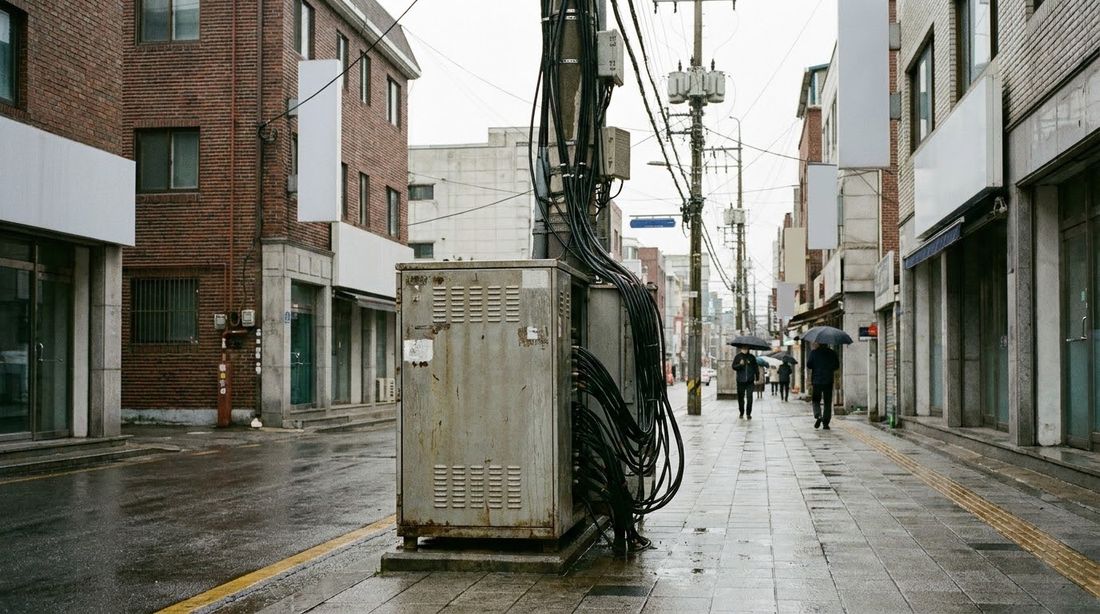
Signing up for home internet in Korea is a shorter story. You look at a price list. The price list is on the carrier’s website, it is the same for everyone, and it has three lines on it.
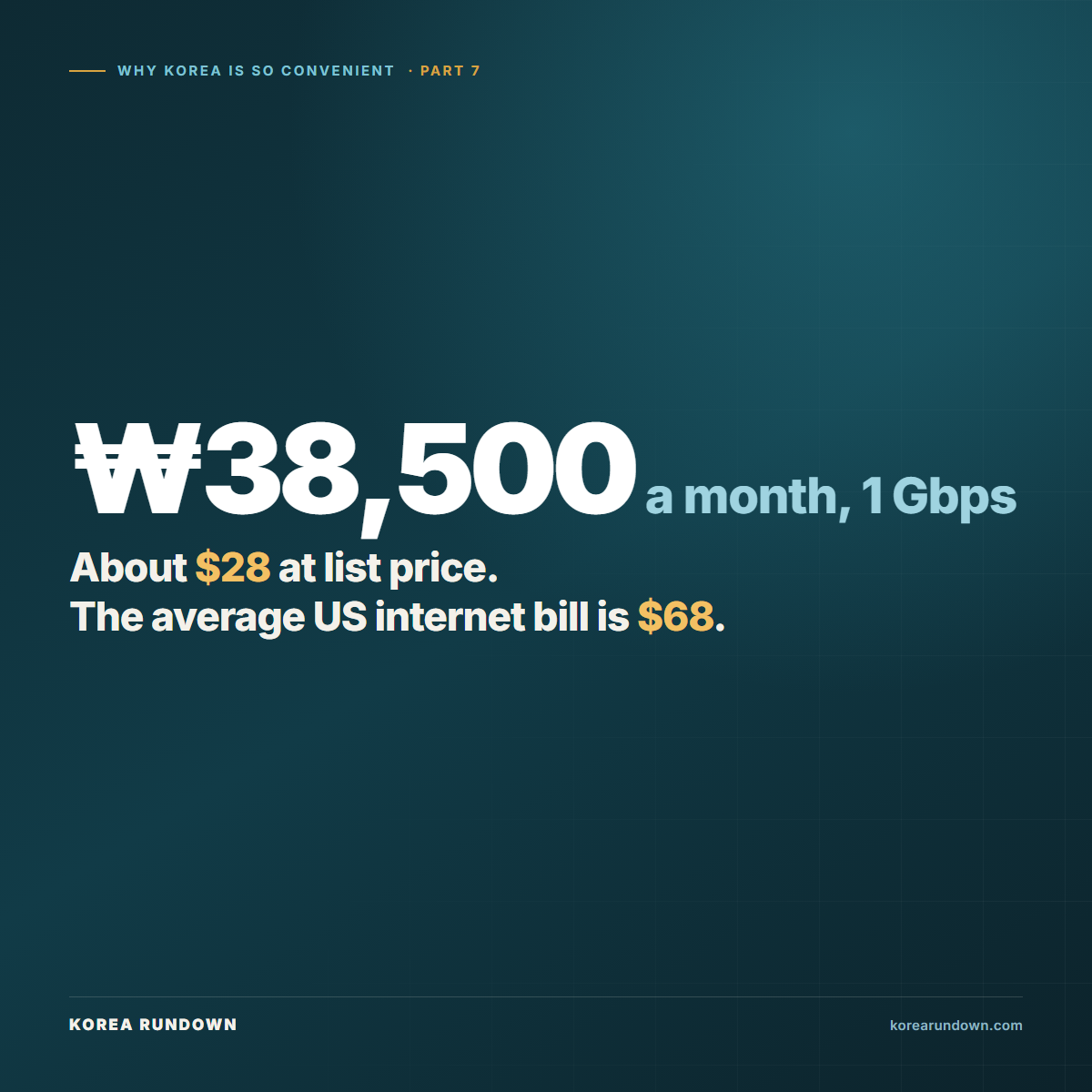
SK Broadband, one of the three national providers, lists 100 Mbps at ₩22,000 a month, 500 Mbps at ₩33,000, and 1 Gbps at ₩38,500. Those are list prices with VAT already included. At the exchange rate in late August 2026 — around ₩1,382 to the dollar — the gigabit line comes to roughly $28.
The average American home internet bill, in a 2025 survey by Reviews.org that combined pricing from close to 100 providers with a 1,000-person consumer poll, was $68.36 a month.
The honest part: Korea is not the fastest country in the world
This is the point where a lot of writing about Korean internet goes wrong, so here it is plainly: Korea has not been the outright global speed leader for years, and pretending otherwise is a decade out of date.
Depending on which month and which index you look at, the top of the fixed-broadband speed table belongs to Singapore, France, and a rotating handful of others, with medians well north of 300 Mbps. Korea sits high in the same table but not at the top, and the United States — which most people assume is far behind — posts median fixed speeds that are broadly comparable to Korea’s in several recent measurement rounds. Published rankings for both countries disagree with each other enough month to month that quoting a specific rank here would be false precision, so this post is not going to quote one.
Two more things worth saying out loud. Korean mobile plans are not cheap; the flagship 5G tariffs are expensive by international standards and have been a live political argument for years. And the Korean fixed market is an oligopoly of three carriers whose real pricing is buried under three-year bundle contracts — tie your phone and your TV to the same company and the internet line drops to around ₩16,500, which is a discount structure Americans would recognize instantly.
The interesting Korean number was never the speed. It is that the floor is high and the price is published.
Why the floor is where it is
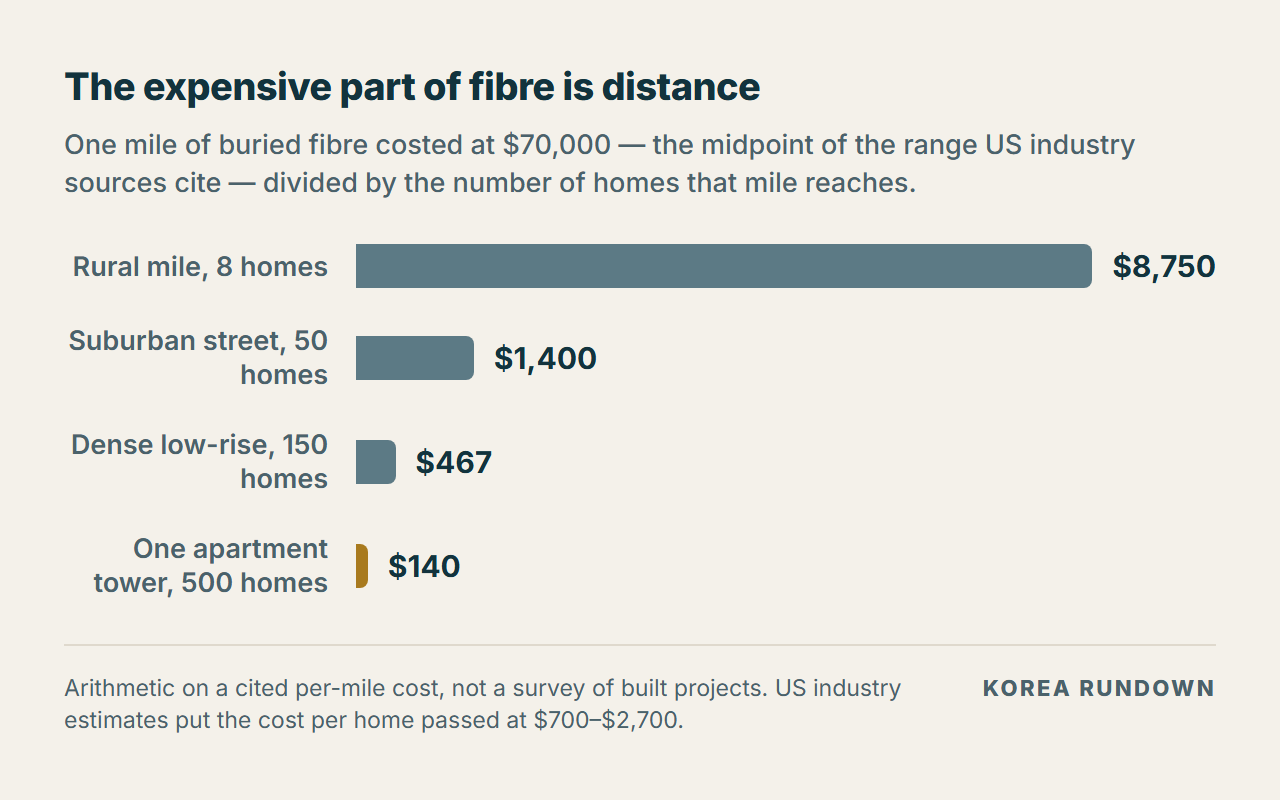
Laying fibre is a civil engineering problem, and civil engineering is priced by distance. Industry estimates for the United States put the cost of laying fibre somewhere in the range of $60,000 to $80,000 per mile, which works out to roughly $700 to $2,700 per home passed depending on what kind of ground you are crossing. Buried runs in rural areas sit at the top of that range, because you are trenching past a lot of nothing to reach the next house.
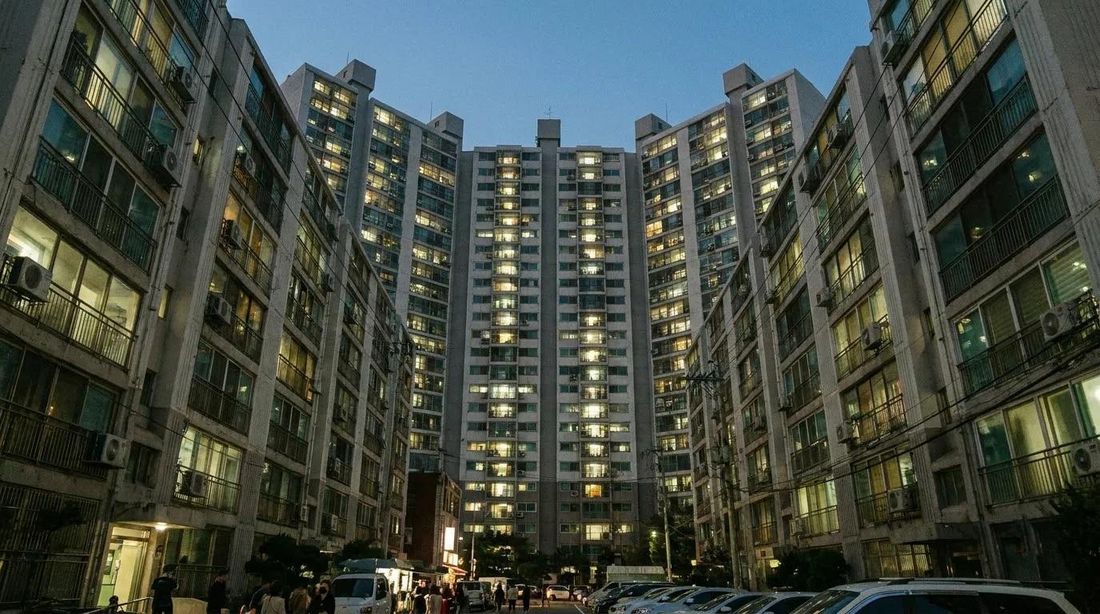
Now do the same arithmetic in a Korean apartment complex. One fibre run reaches the building. The building contains 500 households stacked vertically on a footprint smaller than an American cul-de-sac. The expensive part — the distance — is amortised across 500 subscribers instead of eight, and the in-building distribution is a riser, not a trench.
Roughly half of South Korea’s population lives in the Seoul metropolitan area, and the majority of the country’s housing stock is apartments. That means the expensive-per-home case is the exception here rather than the norm. A carrier can price a gigabit line at ₩38,500 and still make money, because the per-subscriber cost of reaching that subscriber is close to the cheapest it can physically be.
What that buys, other than a lower bill
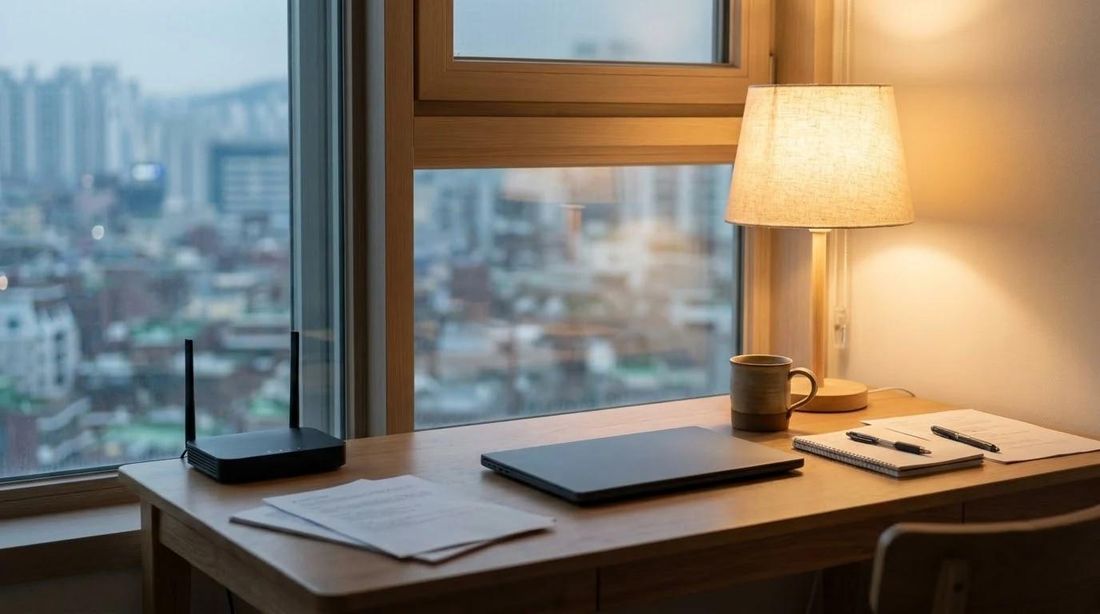
The part that is harder to see from outside is the absence of a decision. There is no tier shopping, no promotional-rate calendar, no equipment rental line, no address lookup to find out whether you get one provider or three. The plan is on a page, the page is the same for everyone, and the number on it is the number.
That is not a cultural preference for transparency. It is what a market looks like when three carriers compete for the same physically dense customer base, where switching cost is low because every building is already wired by all of them, and where no carrier has a geographic monopoly to defend — because there is no geography to monopolise. The apartment tower that made the fibre cheap also made the customer easy to poach.
American internet pricing is not expensive because American companies are greedier. It is expensive because the country is 3.8 million square miles and the customers are spread across it. Korea is the same argument, run in reverse.
This is part 7 of a series on why daily life in Korea feels so frictionless. Part 6 covered what actually changes when the homicide rate is one-twelfth of America’s — and what does not.
Next in this series: Korea’s 24-hour culture is real, and it is quietly shrinking. The reason is a number you can read off a payroll calculation.


Comments
Post a Comment