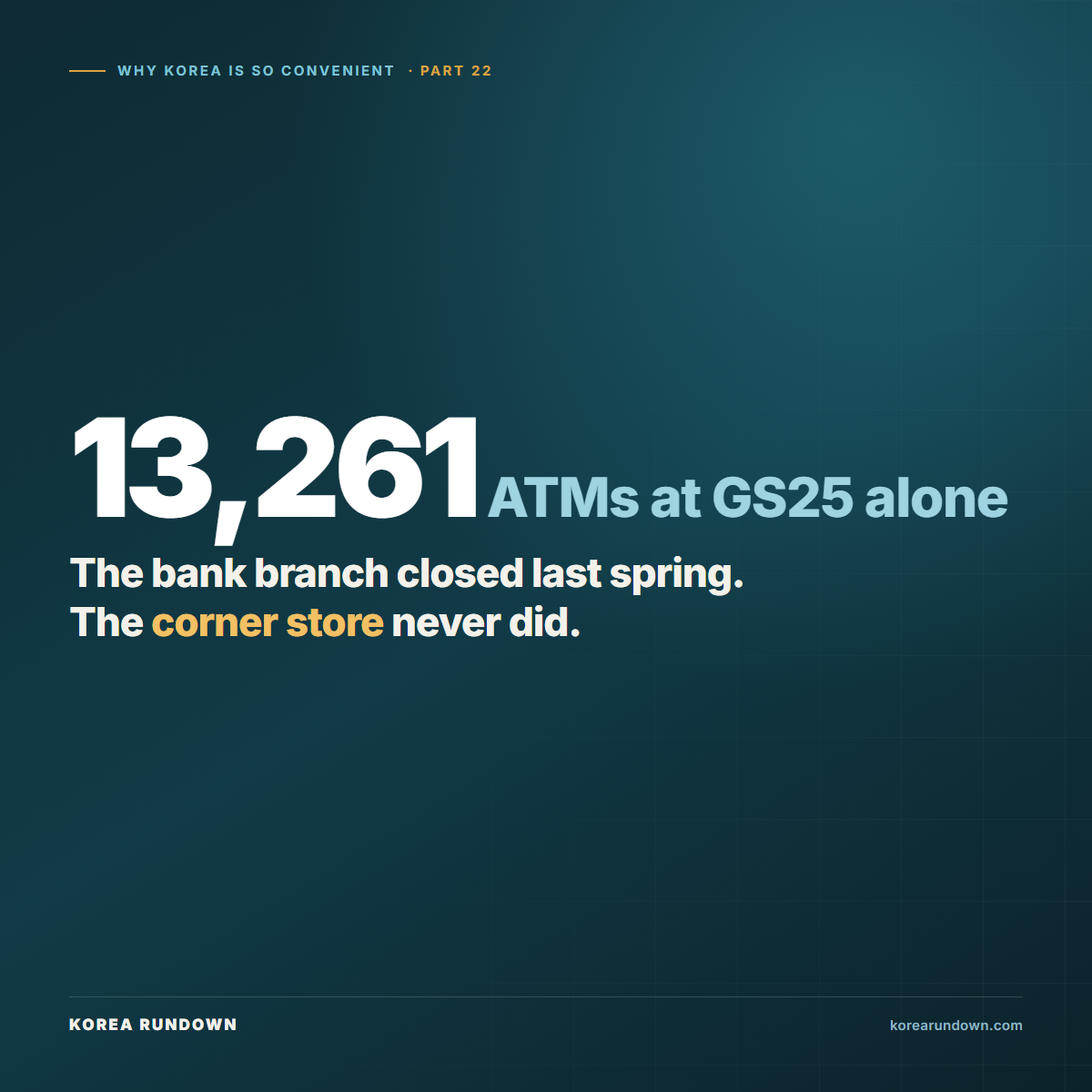
GS25 Alone Runs 13,261 ATMs. Korea's Convenience Stores Quietly Do a Bank Branch's Job.
The branch you used to walk your utility check into closed last spring. The nearest one left standing is now a fifteen-minute drive, and the ATM outside it charges you a fee for the privilege of taking out your own money. You are not alone in this: U.S. banks closed a net 944 branches in the first three quarters of 2024 alone, and the number of Americans living in a so-called banking desert — a neighborhood with no branch nearby — has climbed to roughly 12.3 million, up 760,000 people in just four years.
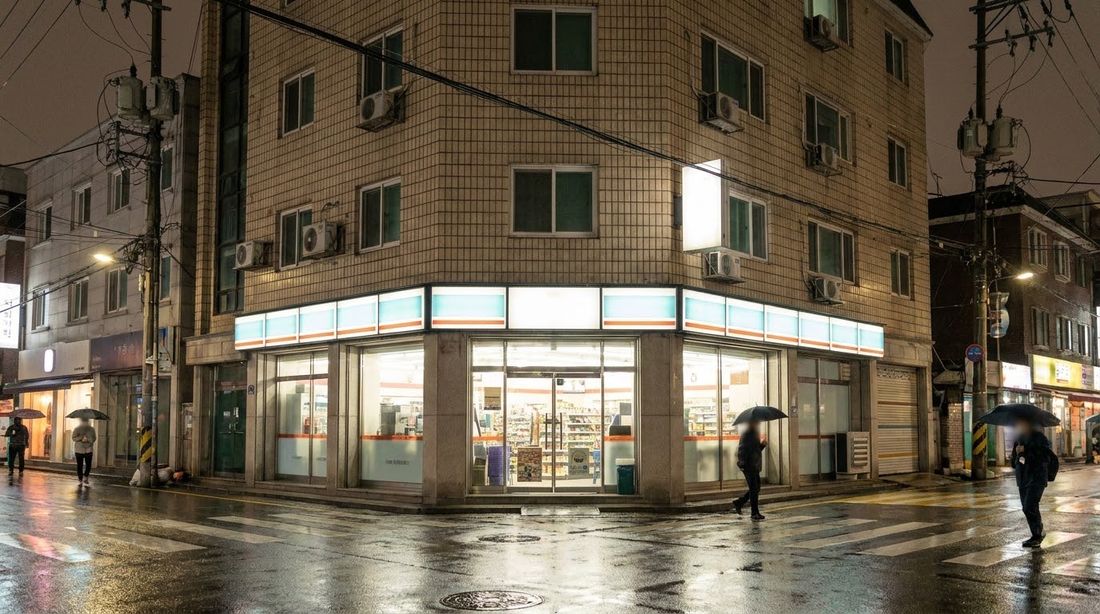
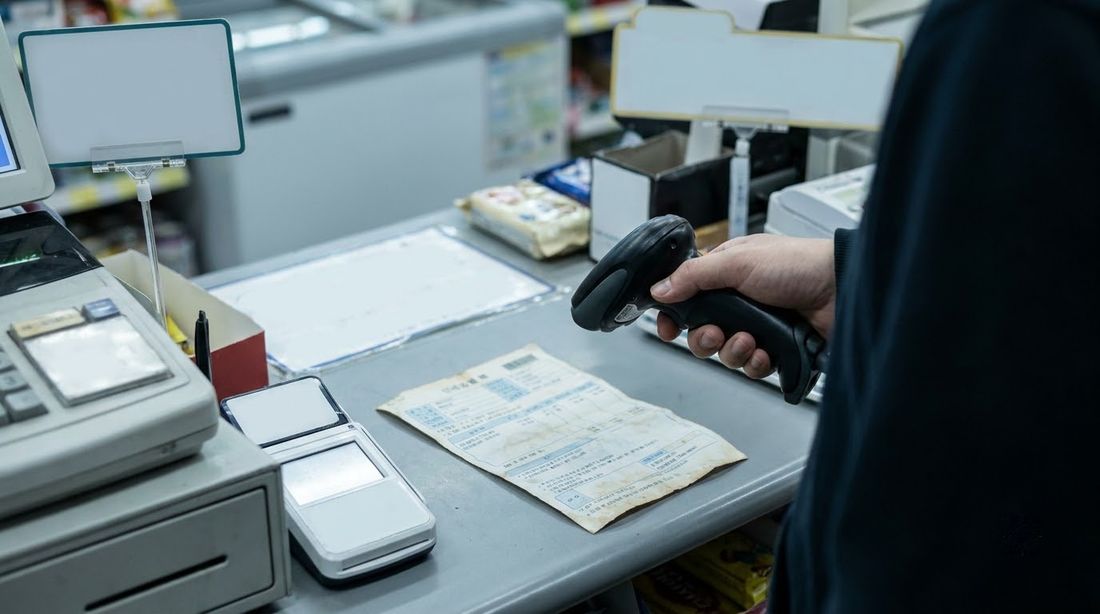
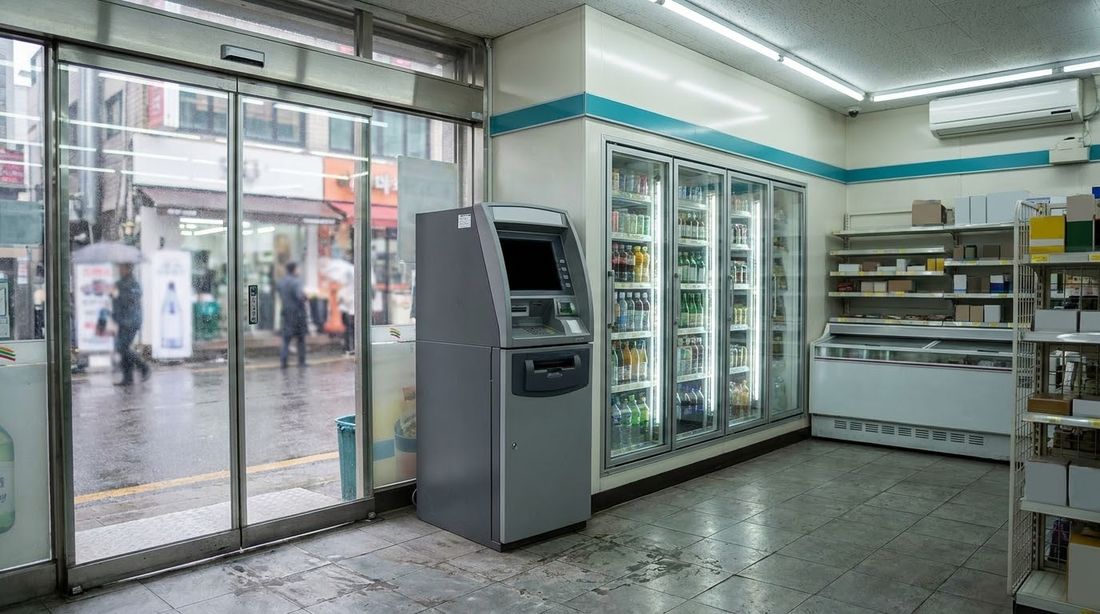
In Seoul, the errand looks different. You walk into the convenience store on your corner — the one you already stop at for coffee — scan the barcode printed on your electricity bill at the register, pay in cash or by card, and you're done in under a minute. On the way out you pull cash from the ATM by the door, no fee, because it's one of the machines the chain rolled out specifically to be free. If a package is waiting for pickup, the same counter hands it over.
One storefront, three counters
None of this is a single service bolted onto a cash register. It's three separate infrastructures riding the same real estate. Utility bills, national pension and health insurance premiums, and local taxes can all be paid at a convenience store counter around the clock, seven days a week, by scanning the payment barcode printed on the standard Korean "giro" bill — a system built for exactly this. Cash machines are the second layer: GS25 alone has expanded its ATM-equipped store count from 11,602 in 2020 to 13,261 by late 2023, and has specifically promoted a fee-free withdrawal option on many of those machines. Parcel pickup and drop-off is the third: customers can send or collect packages at the counter through each chain's own courier partnership, though the discount version only works within the same brand — a GS25 parcel has to start and end at a GS25, not a CU.
Why this isn't really about ATMs
It's tempting to read this as Korea simply installing more cash machines. That misses the actual mechanism. A physical bank branch exists to do three things: dispense cash, accept payments, and move parcels of paper and packages between people. A branch is expensive precisely because it has to do all three under one roof, staffed, on its own lot, with its own security and its own lease. Korea didn't build a cheaper bank branch. It distributed those three functions across a retail network of roughly 53,000 to 55,000 convenience stores that already existed for an entirely different reason — selling coffee and instant noodles to people who live within a few minutes' walk — and let each function ride along as close to free marginal cost as a barcode scanner and a cash machine allow.
The honest part
This system has real seams. The parcel discount that makes convenience-store shipping cheap only works brand-to-brand, so the option that's fastest for you depends on which chain happens to be closer, not which one you'd actually pick. The store network itself is no longer expanding the way it once did — the total count of convenience stores nationwide actually slipped from about 54,852 in 2024 to roughly 53,266 in 2025, with sales growth falling to under half a percent, as the market matures and margins tighten for the chains running it. And a convenience-store counter still can't do everything a bank does: it won't open an account, extend a loan, or handle anything beyond cash, bills, and packages. It is a very good substitute for the errands people actually run most often, not a replacement for a bank.
What density actually buys you
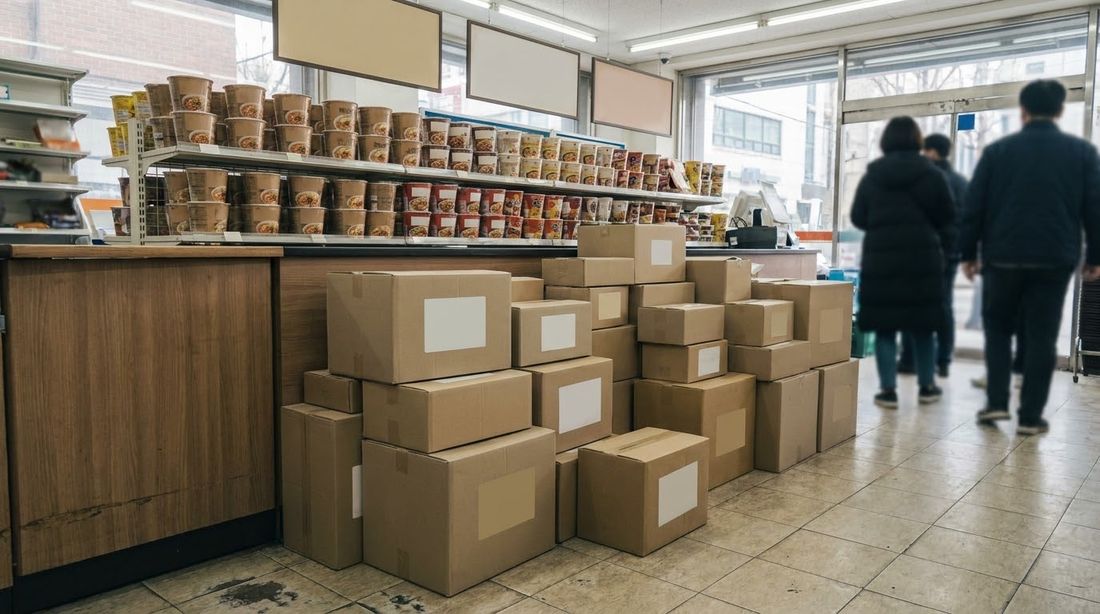
A store within a five-minute walk of almost everyone is the same asset this whole series keeps returning to. Once that store exists, stacking a bill-payment barcode scanner and a cash machine on top of it costs the operator almost nothing extra, because the real estate, the staffing, and the foot traffic were already paid for by the coffee and instant noodles. Try the same trick in a place built around driveways instead of sidewalks, and there is no existing corner store to attach the ATM to — so the bank has to build, and now increasingly close, an entire branch just to do the one thing a Korean convenience store does on the side.
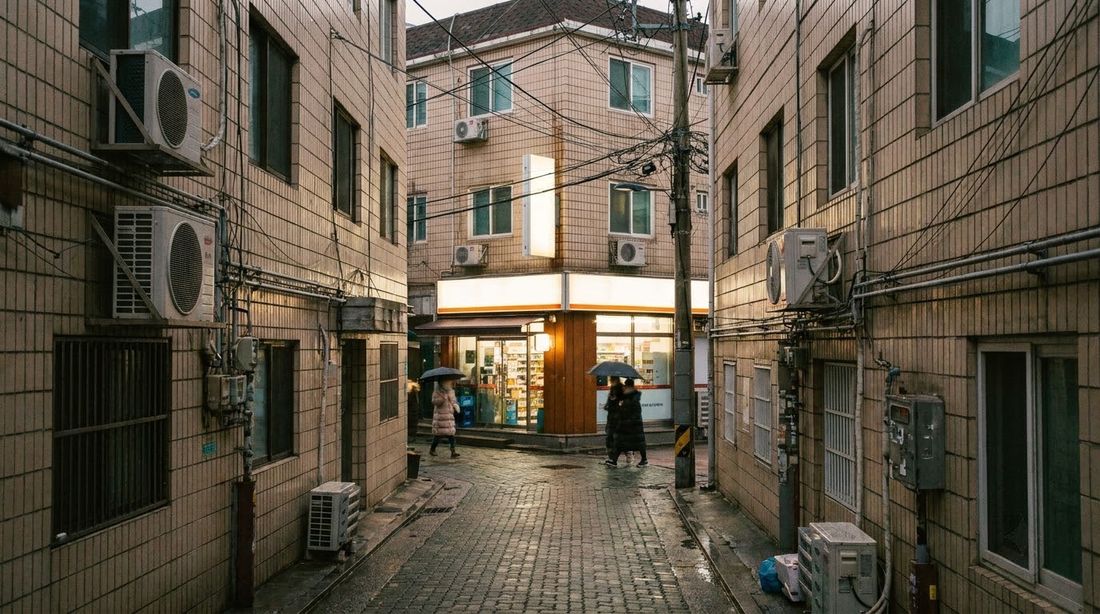
This is part 22 of a series on why daily life in Korea feels so frictionless. Part 21 looked at why Korea can run on almost the same number of doctors as the U.S. and still get you seen faster. Earlier parts are here.
Next in this series: another everyday errand in Korea that runs on infrastructure built for something else entirely.


Comments
Post a Comment